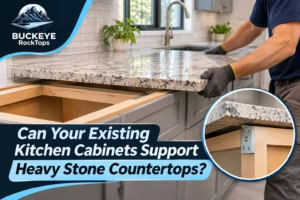
Replacing laminate or another lightweight countertop with granite or quartz does not always require new kitchen cabinets. Many existing cabinet systems can remain in place, provided they are stable, properly secured, and suitable for the planned stone. Cabinet fronts can conceal weakened joints, damaged panels, or uneven supports beneath the old countertop.
Cabinet support for stone countertops depends on the entire assembly rather than a single weight rating. A fabricator must check the load path, the level of cabinet tops, and support around openings. Checking those details before stone is fabricated is often less disruptive than discovering a problem when the slab arrives.
Can You Install Granite or Quartz on Existing Kitchen Cabinets?
Yes, if the cabinets are in suitable condition and meet the stone manufacturer’s support requirements. Cambria advises that walls and cabinetry be structurally sound, straight, level, and square before quartz installation. Older cabinets are not automatically unsuitable. Their construction, fastening, and condition matter more than age, requiring an assessment beyond appearances.
What Determines Whether Cabinets Can Carry Stone Safely?
Cabinet Box Construction and Condition
The cabinet box consists of side panels, a back, a bottom, and the rails or other components that keep it rigid. Well-connected panels can transfer countertop loads downward, while split particleboard, loose joints, or deteriorated framing may not perform reliably. Inspect the cabinet interior, especially under the sink and at the ends of long runs. Doors and drawer fronts reveal little about the structure behind them.
Fastening Between Cabinets, Walls, and Floors
Adjacent base cabinets should behave as a stable system rather than independent boxes that can shift when loaded. Installers look for secure connections between units and appropriate fastening to the building where required by the cabinet design. Loads must reach the floor. Adding a thick board cannot correct poor fastening or weak floor support.
Flatness and a Continuous Supporting Plane
A countertop should rest on support that is sufficiently flat and aligned for its material and layout. One cabinet sitting higher than its neighbor can concentrate pressure instead of distributing it evenly. Cambria and MSI publish different numerical tolerances, so the selected product’s current installation instructions should control the measurement. A fabricator should check levels and correct problems before templating.
Does Stone Weight Require a Special Type of Cabinet?
Granite and engineered quartz are substantial materials, but there is no reliable universal cabinet weight capacity that applies to every kitchen. The load depends on slab size, material density, thickness, sink selection, and the cabinet layout. A run of closely spaced, sound base cabinets behaves differently from a narrow cabinet supporting a large unsupported section. The question is whether the actual support system suits the proposed design.
What Warning Signs Suggest Existing Cabinets Need Attention?
Look for cabinets that rock or shift, visible gaps between adjoining boxes, cracked rails, loose fasteners, or side panels that bow under ordinary use. Misaligned drawers and rubbing doors can indicate movement, though hardware may be responsible. Pay special attention to a base cabinet that has pulled away from a wall or visibly dropped at one corner, because the stone should not be expected to stabilize it.
Water damage deserves a separate check. Swollen particleboard, peeling cabinet surfaces, soft material around plumbing, and musty odors may indicate that parts of the box have lost integrity. An old stain alone does not prove structural weakness, but a damp, crumbling panel needs investigation before loading it with stone. If the floor beneath the cabinets has settled or become damaged, the cause should be addressed rather than concealed with additional shims.
Why Is the Sink Base Cabinet Especially Important?
The sink cabinet often contains plumbing penetrations and has less uninterrupted top framing than neighboring cabinets. Past leaks can weaken the bottom panel or the side walls without being obvious from the doorway. An undermount sink also introduces a separate load from the sink, water, and dishes. MSI recommends supporting sinks independently of its Q countertop material with an appropriate sink-setting or rail system, rather than assuming the stone alone should carry everything.
Do Uneven Cabinets Always Have to Be Replaced?
Not necessarily. Minor differences may be corrected by properly leveling and securing the cabinets or using approved shimming methods where the stone installation allows them. The important distinction is between small alignment corrections and a cabinet box that is twisted, deteriorating, or moving. Excessive shims cannot safely bridge widespread gaps or compensate for an unstable, sloping floor; correct the underlying problem before final templating.
Which Kitchen Areas Commonly Need Additional Support?
Dishwasher openings, wide cabinet spans, sink and cooktop cutouts, and some joints deserve special attention because continuous cabinet support is interrupted. A fabricator may specify rails, structural members, or other support components based on the slab system. Cambria’s technical guidance, for example, calls for support near cutouts and at seams. These are layout-specific requirements; adding a random strip of plywood after a countertop has been cut is not a reliable substitute for proper planning.
An island seating extension is a different concern from the capacity of the cabinets directly beneath the main countertop. Unsupported stone projects beyond the cabinet edge and may need brackets, steel, corbels, or other elements designed for that layout. The applicable dimensions differ by brand and slab specifications. If seating is part of the project, the separate guide to kitchen island overhang support addresses that design question in greater detail.
How Can Existing Cabinets Be Reinforced for Stone?
Where the cabinet boxes are fundamentally sound, reinforcement may be more practical than replacing the whole kitchen. Depending on the inspection, a qualified cabinet installer may secure loose connections, replace damaged support rails, strengthen end panels, or provide properly anchored framing at an unsupported opening. The work must create a dependable path for the load, not just make the cabinet top look thicker. The stone fabricator should approve the intended support arrangement.
A full substrate or additional bracing is not automatically necessary beneath every granite or quartz slab. Requirements depend on the stone’s properties, the manufacturer’s instructions, the locations of cutouts, and the spans between supports. Some designs need support that extends down to the floor rather than a bracket fastened into weak cabinet material. If the work involves substantial structural alterations, have an appropriately qualified professional design and verify the reinforcement before fabrication.
When Is Replacing the Cabinets the Better Choice?
Replacement becomes more sensible when several boxes have swollen or fractured panels, widespread loose joints, persistent instability, or damage that prevents secure fastening. It may also be preferable when changing the kitchen footprint, relocating major appliances, or repairing a failing floor would require dismantling much of the existing installation. A few years of age or cosmetic wear are not enough to justify replacement by themselves; the issue is whether the supporting structure can be made reliable.
What Happens During a Professional Support Assessment?
A useful assessment begins with the proposed stone layout and the condition of the existing bases. The fabricator checks cabinet alignment, accessible rails and panels, sink openings, unsupported spans, and the likely need for reinforcement. They should also clarify which trade will complete cabinet repairs before stone measurements are finalized. Buckeye Rock Tops describes checking base support conditions as part of its countertop installation service, making this a relevant question to raise before committing to a slab.
How Should You Prepare the Kitchen for an Inspection?
Clear the countertops and empty enough of the sink base and adjoining units for the installer to examine rails, connections, and signs of moisture damage. Mention any past plumbing leaks, sticking doors, or areas where cabinets move. Have the proposed sink and appliance specifications available if they are changing. Avoid removing structural cabinet parts yourself to create access. The goal is to let the professional evaluate the assembly in its real operating condition.
Frequently Asked Questions
Can Older Cabinets Hold Granite Countertops?
Yes, some older cabinets can support granite if their boxes, fastening, floor support, and top alignment remain suitable. Age by itself does not establish strength. Solid-looking doors may conceal weak joints or water-damaged panels, so an inspection should concentrate on the structural parts of the bases. The granite selection and planned sink or overhang also affect the support needed. A fabricator should verify those details before stone is ordered.
Are Quartz Countertops Too Heavy for Standard Cabinets?
Not automatically. Many conventional base-cabinet installations can be suitable for quartz when they are sound, level, correctly secured, and appropriately supported. There is no single weight rating that proves every cabinet safe because construction methods and layouts differ. Manufacturer guidance also sets requirements around cutouts and unsupported spans. Have the specific cabinet arrangement evaluated rather than relying on a broad statement that all standard cabinets can hold quartz.
Will Adding Plywood Make Weak Cabinets Strong Enough?
A plywood subtop can be part of an approved support design, but it does not repair loose cabinet joints, rotten side panels, failed fasteners, or an unstable floor. Certain materials and slab designs call for additional substrates, while others do not. The important question is where the loads go after plywood is added. A fabricator and cabinet specialist can determine whether strengthening the underlying structure is necessary first.
Should Cabinets Be Replaced Before a Stone Countertop Is Measured?
If cabinet replacement is necessary, it should generally be completed and the new units secured before final measurement. The same applies to significant leveling or support changes that alter the countertop footprint. Manufacturers advise that supporting cabinetry be in its final position for templating. If a professional determines the existing cabinets can remain, repairs and reinforcement should still be resolved before the finished stone is fabricated to those dimensions.
Check the Cabinet Support Before Choosing the Final Slab
Keeping your existing cabinets can make a stone countertop upgrade practical, but only when the support beneath the surface is sound. Check for movement, damaged panels, uneven tops, and unsupported openings before approving the design. Buckeye Rock Tops works with granite and quartz countertop projects in Columbus, OH. To discuss whether your current cabinets are ready for a stone upgrade, contact Buckeye Rock Tops or call (380) 266-7082 for an installation consultation.