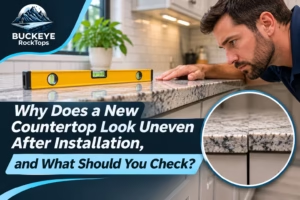
A newly installed stone countertop should look straight and sit securely on its cabinets. Yet a kitchen can appear crooked as soon as the installer leaves. One end may seem higher, a backsplash gap may look wider, or light may catch a slight step where two pieces meet. Those clues are worth checking, but they do not all point to the same problem.
An uneven countertop after installation may be genuinely out of level, insufficiently supported, or simply appear slanted against cabinets and walls that were never perfectly straight. The best first step is to separate visual differences from measurable ones. A few careful observations can help you describe the concern accurately without loosening heavy stone, pulling out shims, or attempting a risky adjustment yourself.
Does an Uneven-Looking Countertop Always Mean Something Was Installed Incorrectly?
Not necessarily. A patterned granite slab can create an apparent slope when its veins run diagonally, while reflected light can exaggerate small changes at the polished edge. A backsplash line or uneven grout joint may also make a level surface look tilted. Compare the front edge against a level rather than assuming the surrounding wall, upper cabinets, or tile pattern is straight.
It also helps to distinguish levelness from flatness. A surface can be relatively flat across its length but slope slightly from one end to the other. Conversely, a counter can be level at its ends yet have a localized high spot or a step at a joint. These conditions require different measurements and different corrections, so avoid describing every visible difference as a warped slab.
How Can You Check a New Countertop Safely?
Place a clean, reliable spirit level on a dry, unobstructed section of the counter, first from left to right and then from the front toward the wall. Repeat the checks along separate sections instead of relying on a single bubble reading. A straightedge can help reveal a localized hollow or raised point. Do not balance a level across a sink opening or a projecting edge that lacks support.
If a section appears uneven, photograph the level in position and record where the reading was taken. Use the same location and orientation for follow-up checks, and note any areas where a straightedge rocks or shows a visible gap. A level indicates a slope, not the reason for it; a fabricator may use more precise instruments and the product’s specified tolerances to determine whether correction is warranted.
Why Might Stone Sit Unevenly Immediately After Installation?
Cabinet Tops Were Not in the Same Plane
Stone is installed over cabinetry or another designed support structure, so misaligned bases can transfer problems to the finished surface. One cabinet may sit slightly higher than the next, or a frame may twist after fastening. A narrow gap under the counter does not automatically establish a defect, but wide unsupported sections or a top rocking on its supports deserve attention. The installer should determine whether cabinet alignment needs correction.
Shims or Support Points Were Placed Incorrectly
Installers sometimes use suitable shims to correct modest irregularities in the supporting structure. The material, location, and extent of that adjustment matter. Concentrating support at a few points can leave adjacent areas inadequately supported, especially near openings or joints. Adding random wedges from inside a cabinet may make the surface look better temporarily while introducing new stresses. Professional correction starts by checking the entire load path, not the visible gap alone.
Adjacent Pieces Were Set at Different Heights
A newly installed counter assembled from multiple pieces can have a small height difference at the meeting point, known as lippage. Even a narrow step is easy to notice when a cloth catches on it or light reflects across the joint. This is an immediate installation-alignment concern, not the gradual filler discoloration discussed in countertop seam maintenance. A fabricator should check whether the pieces can be aligned within the requirements for that material.
Could the Stone Itself Be Out of Flat?
Yes, but check cabinet and installation conditions before blaming the slab. Natural stone can have minor dimensional variations, and individual products may have manufacturing or fabrication tolerances. An edge profile can also create an optical effect when its thickness changes slightly. A long straightedge across an appropriate finished section helps distinguish local variation from a counter that slopes as one unit. Compare measurements with product specifications before considering changes to the stone.
What Do Manufacturer Installation Tolerances Actually Tell You?
Specifications are useful because “it looks off” is difficult to evaluate consistently. Cambria’s published technical guidance calls for a support structure that resists deflection and limits how far it can depart from a plane over a stated distance. MSI’s Q installation guidance sets a different flatness requirement for cabinet tops. These instructions address preparation and support; they should not be treated as one interchangeable rule governing every finished granite or quartz countertop.
Ask the installer which product and thickness were supplied, what support standard was used, and how the questionable section was measured. For example, an uneven cabinet top and an uneven finished seam are separate findings. They may be governed by different requirements. A documented measurement tied to the relevant manufacturer guidance is more useful than applying an arbitrary household tolerance or comparing your kitchen with photographs of another installation.
What Can Countertop Gaps Reveal About the Installation?
Wall gaps can be noticeable even when the counter is level. Walls may be bowed, and a backsplash may cover appropriate clearance. However, a growing gap beneath the stone, an unsupported corner, or an overhang that visibly changes depth can indicate a cabinet or placement issue. Check where the gap occurs before deciding it should be filled. Unequal front overhangs may also indicate placement or cabinet alignment concerns.
When Should You Ask the Installer to Return?
Contact the installer promptly if a reliable level shows a repeatable slope, an edge sits noticeably higher at a new joint, or the stone seems to move under ordinary light contact. Cracks, unsupported spans, widening gaps at cabinet tops, and fixtures that no longer fit correctly also justify a professional review. Avoid using a questionable overhang as seating or placing concentrated heavy loads near an area you suspect is unstable.
When reporting the problem, include the installation date, the affected location, a few clear photographs, and a simple description of what you measured. Mention whether the issue was visible at handover or appeared after the installation crew left. Ask for a return inspection and a written explanation of the proposed correction. Do not assume the source is settling or defective stone before the installer has evaluated the supporting cabinets and slab.
How Can Professionals Correct a New Countertop That Is Out of Level?
Corrective work should address the cause instead of merely hiding the uneven appearance. If cabinets are not in the same plane, a cabinet specialist may need to adjust and secure them before the stone is reset. If support spacing or alignment was wrong, the fabricator may need to reposition the top or install an appropriate support arrangement. Any intervention must preserve safe support near cutouts, joints, and overhangs. Lifting stone or releasing adhesive requires professional handling and planning.
What Should You Avoid Doing Yourself?
Do not pry up the counter, force shims into a gap, remove fasteners, or try to sand a high section of stone. These actions can crack brittle materials, damage cabinetry, disturb a sink seal, or create unsafe support conditions. Similarly, adding caulk to conceal a large gap can make later diagnosis harder. Keep the surface free of unusually heavy loads until the installer confirms that the support and placement are suitable.
What Should Be Checked Before You Accept the Finished Installation?
Before accepting the finished work, review the front-edge line, visible wall gaps, adjacent countertop heights, and whether the stone sits securely. Buckeye Rock Tops lists cabinet leveling, base-support checks, and fitting stone surfaces among its countertop installation services. When arranging an inspection, ask the installer to explain whether the issue is visual, a cabinet-plane problem, or a measurable surface variation. That distinction matters because each condition needs a different response.
Frequently Asked Questions
Can a Countertop Be Level While the Cabinets Look Crooked?
Yes. A properly positioned countertop can appear uneven against wall tile, a backsplash line, or cabinet doors that are not aligned with one another. The visual difference may come from the surrounding finishes rather than the stone surface. A reliable spirit level and straightedge help identify what is actually changing. If measurements look consistent but the appearance remains distracting, ask the installer to review the trim, cabinet faces, and wall transitions.
Is a Small Height Difference at a New Countertop Joint Normal?
Very small surface differences can be visible on polished stone, but acceptable lippage depends on the material and the applicable fabrication or installation guidance. Do not assume that every detectable step is acceptable or that any visible line requires replacement. Record whether a cloth catches on the joint, photograph the location, and ask the fabricator to measure it against the relevant specification. A new alignment issue deserves attention before the area receives heavy use.
Can You Fix an Uneven Granite or Quartz Countertop With Shims?
Sometimes shimming is part of a professional correction, but it is not a universal solution. The installer must evaluate cabinet alignment, support continuity, adhesive placement, and the stone’s existing condition. A shim that lifts one location can also change stresses elsewhere, particularly around cutouts or joints. Do not insert wedges yourself or treat a large unsupported gap as a cosmetic issue. Appropriate correction may require adjusting the cabinets before repositioning the stone.
Should You Expect the Countertop Installer to Come Back After Installation?
If a measurable problem or possible support issue is discovered promptly, requesting a return inspection is reasonable. Whether correction is included in the original agreement depends on the contract, the condition found, and who was responsible for cabinet preparation. Provide clear photographs and measurements, then ask for written findings and a proposed remedy. Avoid assuming that a visual difference proves faulty installation, but do not ignore movement, cracks, or missing support.
Get the Alignment Checked Before Small Concerns Become Bigger Ones
A new countertop can look uneven because of surrounding finishes, cabinet alignment, localized height differences, or the stone itself. The first step is to verify the condition without disturbing the installation; the next is to have the fabricator identify the source and compare it with the proper specifications. For a countertop installation concern in Columbus, OH, contact Buckeye Rock Tops or call (380) 266-7082 to discuss an evaluation.