A countertop edge meets the busiest parts of a kitchen. Shopping bags brush past an island, cookware touches the front rim, and someone occasionally bumps a heavy serving dish against a corner. These ordinary contacts make edge shape worth considering before a slab is fabricated. An attractive profile is not necessarily fragile, but two designs that look similarly straight can behave differently when struck.
For homeowners comparing chip resistant countertop edges, softened profiles are generally a more practical starting point than truly sharp, square corners. A full bullnose offers a continuously rounded front, while an eased or half bullnose edge can balance a clean appearance with reduced sharpness. None is chip-proof. The material, size of the radius, fabrication quality, and location of the edge all influence how it performs.
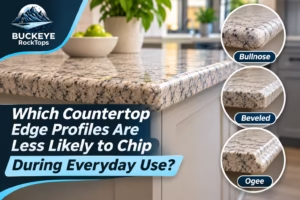
Which Countertop Edge Profiles Tend to Resist Everyday Chips?
Rather than treating one profile name as a durability guarantee, compare how much exposed sharpness remains at the places most likely to be hit. Caesarstone recommends rounding or beveling its exposed quartz edges and cautions against square, sharp profiles. Cambria likewise describes bullnose profiles as practical for busy households. Those manufacturers offer useful design principles, although their exact specifications apply to their own products.
| Edge profile | Shape | Everyday-use consideration |
| Eased | Straight face with softened corners | Practical balance when the radius is adequately finished |
| Full bullnose | Continuously rounded face | No abrupt upper front corner; forgiving shape for frequent contact |
| Half bullnose | Rounded top, straighter lower section | Softer upper edge with a more defined lower silhouette |
| Beveled | Angled flat cut at the front | Removes a sharp corner, but the transitions also need finishing |
| Ogee | Decorative curves and transitions | Attractive detailing; requires particular care at projecting contours |
Why Does a Rounded Edge Handle Impacts Differently?
A tiny contact area can concentrate the force of a pot striking stone. Rounding an exposed edge replaces an abrupt corner with a curved surface, which can reduce that concentration in some everyday impacts. Caesarstone’s fabrication guidance expressly recommends a minimum rounded or beveled treatment to limit chipping of its quartz. This is a design advantage, not a promise that a rounded edge will survive a hard blow from every direction.
Edge radius matters more than the label on a showroom sample. Two installers may both call a profile “eased,” yet produce noticeably different amounts of rounding. Ask to see the actual finished profile and confirm that its radius follows the selected slab manufacturer’s guidance. Avoid adopting a specific millimeter measurement from another brand as a universal requirement for granite, marble, and engineered quartz.
Is an Eased Edge a Good Choice for a Busy Kitchen?
An eased countertop edge looks nearly straight from across the room, but the top and often bottom corners are gently softened. It is a useful choice when homeowners want contemporary lines without leaving the stone with a knife-like front corner. Its smooth, uncomplicated shape is also easy to wipe clean. The protective benefit depends on how the fabricator finishes the edges, not simply on selecting “eased” from a catalog.
Does a Full Bullnose Offer Better Protection?
A full bullnose edge curves around the entire front face, eliminating a distinct sharp upper edge. That rounded transition makes it worth considering for island seating, family kitchens, and other places where people frequently pass close to the counter. It also feels softer when leaned against. However, its sweeping curve may not suit every cabinet style, and concentrated impact can still chip stone despite the gentler outline.
Where Does a Half Bullnose Fit Between Those Choices?
A half bullnose edge rounds the upper section while leaving more definition toward the bottom. It can provide a softer touch where hands, plates, and pans most often meet the countertop without producing the fully rounded appearance of a bullnose. The remaining lower transition still needs appropriate finishing, particularly on exposed island edges. Ask for a physical sample, since half bullnose and demi bullnose labels sometimes describe different shop-specific shapes.
Are Beveled Countertop Edges Resistant to Chipping?
A beveled edge replaces part of a square corner with a sloping flat face, often creating a crisp geometric look. That angled cut can avoid the vulnerability of a completely sharp corner, provided its transitions are also softened as required for the material. A narrow bevel with hard, unrelieved transitions is not automatically a stronger choice than a properly rounded edge. What matters is the completed geometry, not the presence of a decorative diagonal alone.
Are Ogee and Decorative Edges More Vulnerable?
An ogee edge uses a sequence of inward and outward curves to create a more ornate appearance. It is not inherently defective or destined to chip, but its detailed contours can create more places to catch a hard object and more surfaces to clean. Cambria notes that elaborate profiles generally require more maintenance than simpler eased or bullnose edges. If appearance is the priority, ask how each exposed transition will be finished and protected.
Does the Stone Material Change Which Edge You Should Choose?
Granite, quartz, and marble vary in composition, and individual natural-stone slabs differ from one another. A profile that works well in a particular engineered quartz product may need adjustment for a granite with prominent mineral features or a marble chosen for its veining. No broad ranking of these materials can predict the survival of every small edge impact. The fabricator should evaluate the actual slab and applicable product guidance.
Why Do Island Corners Need Separate Attention?
The front edge profile describes the stone’s cross-section; the outside corner describes the countertop’s shape when viewed from above. These are separate decisions. An island can have a bullnose front yet still end in an abrupt ninety-degree outside corner that people or objects strike. Slightly rounding exposed plan-view corners may make those locations more forgiving in a busy walkway, provided the design and fabrication allow it.
How Much Does Fabrication Quality Affect Edge Durability?
A well-chosen profile needs consistent cutting, polishing, and edge finishing to perform as intended. Uneven radii, unpolished transitions, or small chips left from machining can undermine an otherwise sensible design. Review a finished sample rather than choosing from a flat diagram alone, and check whether the shop will soften both upper and lower exposed corners. The fabricator also needs to account for the slab manufacturer’s instructions and any project-specific limitations.
Buckeye Rock Tops describes edge detailing, precision cutting, and shaping as part of its countertop fabrication work in Columbus, OH. That is a relevant stage to discuss the planned profile, its finish, and the amount of exposed rounding before a slab is cut. Ask which samples are available for your selected stone rather than assuming every catalog profile can be produced identically in every material.
What Everyday Habits Help Prevent Countertop Edge Chips?
Even a thoughtfully rounded edge can break when hit by a heavy cast-iron pan or dropped metal appliance. Set down cookware rather than sliding it over the front, and lift small appliances when moving them. Be especially careful around island corners, where bags and carts may bump the stone. These precautions are simple, but they address the direct impacts that edge shape alone cannot eliminate.
Clean exposed edges using methods approved for the specific stone or quartz product. Abrasive tools and improvised grinding can damage the finish or create sharp spots instead of making it safer. If a chip does occur, photograph it and avoid picking at loose fragments. A fabricator can determine whether a localized repair is reasonable without treating every small nick as evidence that the entire countertop must be replaced.
Which Edge Profile Makes Sense for Your Kitchen?
For a heavily used family kitchen, a full bullnose or generously softened eased edge is a practical short list. A half bullnose offers a middle ground, while a properly finished bevel can suit a more angular design. Choose an ogee primarily because you like its appearance and accept its extra detailing. Before approving the order, compare physical samples, ask about the radius, and identify the most exposed corners in your layout.
Frequently Asked Questions
Is a Straight Countertop Edge More Likely to Chip Than a Rounded One?
A truly sharp, square stone edge can be more vulnerable to an impact than a properly softened or rounded version. However, many products sold as straight or square edges already have a small easing radius, so the name may be misleading. Look at the actual profile and ask the fabricator how its exposed corners are finished. The stone material and force of the impact still matter, and no profile eliminates chipping.
Is Bullnose Better Than Eased for Granite Countertops?
A full bullnose offers more continuous rounding, which may appeal to households with frequent edge contact. A well-finished eased profile can also be a durable, practical option, particularly if a straighter appearance suits the kitchen. Granite slabs vary in their mineral features, and individual fabrication details matter. Ask the fabricator to examine the selected slab and show both finished profiles rather than assuming the bullnose always wins.
Can You Change the Edge Profile on an Installed Countertop?
Sometimes a stone professional can refinish or modify an accessible edge, but the feasibility depends on the material, existing shape, thickness, and space around cabinets and appliances. Reshaping creates dust and other fabrication hazards and can change the appearance of the finished counter. It is not a household sanding project. Have a fabricator evaluate the actual installation before assuming a sharp edge can safely become a full bullnose.
Do Rounded Countertop Edges Eliminate the Need for Care?
No. Rounding can reduce certain edge-impact vulnerabilities but does not prevent chips caused by heavy blows, weak support, or damage elsewhere in the slab. Keep heavy cookware from striking the rim, use appropriate cleaning methods, and watch for newly fractured corners. If a chip has sharp edges or seems to grow, have a stone professional assess it. Design choice and careful use work together rather than substituting for each other.
Choose an Edge That Fits the Way You Use the Kitchen
The most practical edge is one that combines a comfortable shape, appropriate rounding, and careful fabrication for the stone you select. Eased, full bullnose, and half bullnose profiles deserve particular attention in busy kitchens, but none guarantees a chip-free surface. For guidance on available stone profiles and a project in Columbus, OH, contact Buckeye Rock Tops or call (380) 266-7082 to discuss the design before fabrication.