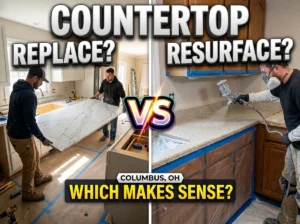
The quick answer: resurfacing can make sense for sound, manmade counters when budget or timing is tight. Countertop replacement is usually the better call when the surface is damaged, you’re staying in the house for years, or you’re changing the layout. Which side your kitchen falls on depends on what the counters are made of, what condition they’re in, and what you want from them.
If you’re comparing countertop replacement vs. resurfacing in Columbus, OH, this guide explains what resurfacing actually is, when it holds up, when it doesn’t, how the costs and lifespans compare, and what replacement involves if that’s where you land.
What Resurfacing Actually Means
“Resurfacing” gets used for a few different things, and the differences matter.
Coating or overlay. This is what most people picture. The old surface is cleaned, sanded, repaired, and covered with a new finish, often an epoxy or acrylic coating, or sometimes a new layer of material. It changes how the counter looks without removing it.
Refinishing natural stone. For granite or marble, “resurfacing” usually means professional polishing or honing and resealing. It refreshes the stone itself instead of covering it.
Replacement. The old tops come out and new slabs or panels go in. Nothing from the old surface remains, including its problems.
The first approach is the one with the biggest trade-offs, so most of this guide focuses on it.
When Resurfacing Makes Sense
Coatings and overlays work best on smooth, manmade surfaces: laminate, cultured marble, solid surface, and sometimes tile. They suit a counter that is structurally sound, with nothing loose, swollen, or water-damaged underneath, where the problem is mostly cosmetic: a dated color, a worn finish, or minor scratches.
It can also fit when your timeline or budget is the priority. Providers commonly estimate that resurfacing costs roughly 30 to 50 percent less than replacement, and it can often be finished in days instead of weeks. If you expect to sell or remodel in a few years, a kitchen countertop makeover that costs less and finishes faster may be a reasonable choice.
Go in with realistic expectations, though. Coated surfaces are generally less forgiving than stone. They can be vulnerable to heat and scratching, and their lifespan varies widely, from a few years to about a decade depending on the method and how the counter is used. Coating also covers a surface instead of fixing what’s wrong with it, so a failing seam or a soft spot from water damage will come back.
For natural stone, the more useful “refresh” is often polishing and resealing. Our countertop sealing and maintenance service covers that kind of care, and it’s usually worth trying before deciding stone needs to be replaced.
When Replacement Is the Better Move
Replacement earns its higher price in a few situations:
- Damage that goes deeper than the surface. Large or multiple cracks, failed seams, and water damage underneath can’t be coated away.
- A layout change. A bigger island, a new sink position, or an upgraded cooktop all require new tops, since existing counters can’t be reshaped to fit.
- A long-term plan. Quartz, granite, and quartzite can last for decades, so a higher upfront cost is spread over many years of use.
- Performance you want to count on. Stone tolerates heat and daily wear better than most coatings, although quartz still needs trivets.
- Surfaces that can’t be resurfaced. Natural stone with real damage, or counters in poor shape, usually isn’t a good candidate for a cover-up.
Replacement also gives you the widest set of custom countertop options: slab, edge, finish, and sink style are all open for decision.
Countertop Replacement vs. Resurfacing at a Glance
| Factor | Resurfacing | Replacement |
| Upfront cost | Often estimated 30–50% lower | Higher |
| Time | Often days, including curing | Longer: templating, fabrication, install |
| Lifespan | A few years to about a decade | Decades for most stone surfaces |
| Heat and scratches | Coatings can be vulnerable | Stone generally handles them better |
| Fixes underlying damage | No, it covers the surface | Yes |
| Layout or sink changes | No | Yes |
| Best fit | Sound laminate, tile, or cultured marble on a short horizon | Damaged counters, remodels, long-term homes |
The right choice also depends on which countertop material suits your kitchen, cooking habits, and maintenance preferences. Before committing to resurfacing or replacement, explore our countertop material comparison guide to compare popular surfaces and understand their differences.
What It Costs
Resurfacing is typically cheaper than replacement up front, and the difference is part of its appeal. Replacement costs more now but spreads that cost over a longer life. For reference, installed stone countertops are generally estimated at $40 to $200+ per square foot, and many Columbus kitchens fall somewhere between roughly $2,300 and $4,700.
Please note: These prices are estimates only and are not confirmed. Final cost depends on project size, material, layout, edge profile, cutouts, labor and installation time, removal of old countertops, the condition of the cabinets, and other factors. A written, itemized quote after measurement is the only reliable number.
For a fuller look at what shapes a quote, see our countertop installation cost guide for Columbus.
Questions to Ask Before You Decide
Instead of asking which option is better in general, ask which is better for your kitchen:
- Is the surface solid? Press along seams and around the sink. Soft spots, swelling, or movement point toward replacement.
- How long will you stay? A short horizon favors resurfacing. Ten years or more favors replacement.
- Are you changing anything else? A new sink, island, or cabinet layout all mean new tops.
- How do you use the counters? Heavy cooking and hot cookware are hard on coatings.
- What are the counters made of? Laminate and cultured marble resurface well. Natural stone usually needs polishing, sealing, or replacement instead.
If most answers lean one direction, you have your decision. If they split, a professional condition check can break the tie.
What a Replacement Involves
A replacement follows a predictable order:
- A review of the existing counters and the cabinets beneath them.
- Material and slab selection, ideally by viewing the full slab in person.
- Templating once the cabinets are confirmed level and secure.
- Countertop fabrication, including edges and cutouts.
- Removal of the old tops, new countertop installation, seam finishing, and sink reconnection.
The same sequence applies to vanity tops in bathrooms, where moisture around the sink makes the condition of the surface and cabinet underneath worth checking.
Material choice shapes the result. Quartz offers low maintenance and consistent patterns. Granite brings natural variation and strong heat tolerance. Marble is prized for its look but needs the most care. Quartzite is a natural stone known for durability and a marble-like appearance. Ask your installer to show you full slabs, and ask how they control dust when stone is cut. Buckeye Rock Tops installs and fabricates countertops for homeowners across Columbus and Central Ohio.
Frequently Asked Questions
Can I resurface granite or quartz countertops?
Coatings aren’t a good fit for stone in good condition, and they cover its natural look. Granite can be polished and resealed, and quartz is typically cleaned and repaired instead of recoated. If either is badly damaged, replacement is usually the sounder fix.
Is resurfacing cheaper in the long run?
Not always. It costs less up front, but if it needs redoing in several years, the savings shrink. Over a long stay, a durable replacement can be the better value.
How long does each option take?
Resurfacing is often a matter of days, including curing time. Replacement takes longer because of templating, fabrication, and installation, and timing varies with slab availability and the project’s complexity.
Ready to Weigh Your Options?
If your counters are damaged, outdated, or no longer fit your kitchen, a professional look can tell you whether a refresh is realistic or replacement is the smarter move. Contact us or call (380) 266-7082 to talk through what you’re seeing and what the next step could be.