The strip of wall between your counter and upper cabinets is small, but it’s the part of the kitchen you stare at while you cook. It’s also what makes the cabinets, countertops, and lighting look like they were chosen together. This guide to kitchen backsplash ideas in Columbus, OH walks through the styles, colors, and materials homeowners are choosing right now, along with the practical details that decide whether a design holds up in a working kitchen.
Here’s the direction in plain terms: warm neutrals, handmade-looking ceramic tile, and stone that climbs higher up the wall are leading the 2026 conversation. How well any of that suits your kitchen depends on your countertop, your light, and how hard the wall works. A backsplash is also one of the few kitchen renovation ideas that changes the whole room without moving cabinets or plumbing, whether it’s a stand-alone refresh or one piece of a larger remodel. The sections below are organized around those decisions.
What’s Trending in Backsplash Design Right Now
The National Kitchen & Bath Association’s 2026 Kitchen Trends Report is a useful reality check. Respondents identified neutrals as the most popular kitchen colors (96%), with greens (86%) and blues (78%) close behind. They also expected new statement colors to land on the backsplash (60%) more often than on islands (57%), and 61% named natural quartzite as a backsplash material. Put together, the backsplash is where many kitchens now add personality while cabinets and counters stay calm.
Designers quoted in 2026 trend coverage point the same way: decorative tile patterns with a handmade, slightly uneven glaze (zellige-style tile is the usual example), full-height stone behind the range, and countertop material carried up the wall. Two things they’re moving away from are high-contrast grout, like black grout on white tile, and the glass tile that was once everywhere.
Treat trends as backsplash inspiration, not a verdict. Across Franklin County, kitchens run from 19th-century cottages in German Village to newer suburban builds, and a look that suits one can feel forced in the other.
Backsplash Styles for Every Kind of Kitchen
The styles below group backsplash design ideas by how you want the kitchen to feel, rather than by what’s popular this year.
Modern and Contemporary
Modern kitchen backsplash ideas tend to rely on fewer lines and quieter surfaces. Large-format porcelain, stacked or straight-set tile, and slab-style stone keep the wall calm, and fewer grout lines means less to scrub. Contemporary backsplash styles go a step further with matte finishes, subtle texture, or a single material running from counter to ceiling. In a kitchen with flat-panel cabinets, texture often does the job pattern would otherwise do.
Farmhouse and Traditional
Farmhouse backsplash ideas lean on familiar shapes: subway tile in a running-bond layout, creamy white or soft sage glazes, and handmade-look surfaces with a little variation. They suit the older homes in neighborhoods like Clintonville, Olde Beechwold, and German Village, where a classic tile respects the age of the house instead of competing with it. For more character, add a mosaic tile panel behind the range or a herringbone layout, and keep everything else simple.
Luxury and Custom
A luxury kitchen backsplash usually means one large piece of stone instead of many small pieces of tile. Veined marble or quartzite, sometimes bookmatched so the pattern mirrors across the wall, turns the backsplash into the kitchen focal point. Custom backsplash designs can also work at a smaller scale, like a mosaic inlay or metallic accent framed by plain tile behind the cooktop. In both cases the expense sits in precise cutting and layout, not just square footage. Buckeye Rock Tops fabricates and installs granite, quartz, and marble countertops and offers stone backsplash installation, including full-height designs fitted around outlets and corners.
Backsplash Color Ideas That Work With Your Cabinets and Countertops
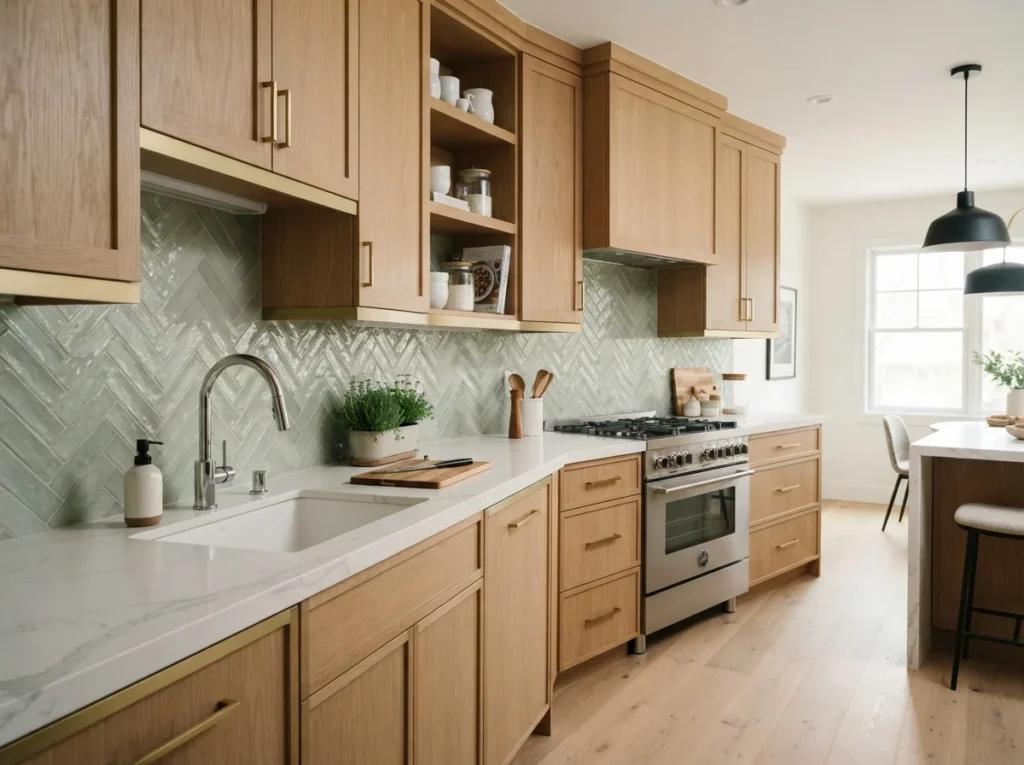
Start with whatever can’t change. If the countertop has heavy veining or movement, a quiet backsplash in soft white, cream, or warm greige keeps the kitchen from feeling busy. A plainer countertop can carry more, such as a muted green or dusty blue, which lines up with the greens and blues in the NKBA findings. Dark or wood-toned cabinets usually look best against a lighter wall, while white cabinets leave room for a deeper color.
Grout is part of the color decision. A shade close to the tile makes the wall read as one surface, while strong contrast makes the layout itself the design, which is the choice many designers are now steering people away from.
Columbus water deserves a thought here too. The city’s Division of Water softens its supply to roughly 120 ppm, about 7 grains per gallon, which the city describes as moderately hard by national standards. In practice, mineral spotting tends to show faster on dark, glossy surfaces near the sink than on lighter or textured ones.
Whatever you lean toward, take samples home and look at them beside the actual countertop in morning and evening light. A tile that looks warm in a showroom can turn cool under your own bulbs.
Choosing Materials: Ceramic, Porcelain, Marble, and Natural Stone
Ceramic offers the widest range of colors, shapes, and glazes, which is why it’s behind most subway tile and handmade-look backsplashes. Porcelain is denser and comes in large formats and stone-look prints, so it’s a common route to a slab-like finish without slab pricing. Glazed ceramic and porcelain generally don’t need sealing themselves, though the grout between them is a separate question (more in the questions below).
Marble is the classic choice and the one with the most trade-offs. It’s a calcium-based stone, so acidic spills like lemon juice, vinegar, or wine can dull a polished finish, a change called etching. Sealing helps against staining but can’t prevent etching, and stone-care guidance generally calls for pH-neutral cleaners. A honed (matte) finish hides etching better than a high polish. Some homeowners enjoy the patina marble develops, while others find it frustrating, so decide which camp you’re in before committing.
Natural stone such as quartzite or granite resists acids better and suits a full-height backsplash. Engineered quartz works too, but it’s resin-bound, so ask the manufacturer about heat limits before putting it behind a range. Homeowners weighing price against upkeep can find a deeper comparison of tile versus stone backsplashes for Columbus kitchens.
Layout and Pattern: Where the Design Comes Together
Pattern changes the character of the same tile. A running-bond subway layout reads classic, a stacked layout reads modern, and herringbone or chevron adds movement at the price of more cuts and more labor. A small mosaic panel behind the range gives the wall a focal point without covering all of it in busy pattern. Ask for the backsplash layout to be planned from the center of the range or sink wall outward, so cut tiles land at the corners instead of the focal point.
Height matters just as much. The standard backsplash stops at the upper cabinets, but running tile or stone to the ceiling, or at least to the range hood, is a current favorite, especially with open shelving. For kitchen wall tile ideas beyond the standard strip, consider tiling the wall behind open shelving or carrying the same tile around a window.
Fixtures belong in the plan early. Outlets and switches that land in the middle of a tile pattern create awkward cuts, and moving them is an electrical job. Kitchen receptacles generally require GFCI protection under the National Electrical Code, so bring in a licensed electrician rather than improvising. Older Columbus homes add another variable: walls that aren’t perfectly flat make large-format tile and slab harder to set cleanly, and the prep work can change the schedule and cost.
Because these details interact, a professional design consultation is worth having before anything is ordered. If you’re planning a kitchen update, learn more about backsplash installation in Columbus, OH and how the right material and layout can bring your design together. If the countertops are changing too, planning your stone backsplash installation alongside them keeps edges, seams, and wall prep coordinated.
What Backsplash Ideas Cost: Rough Planning Ranges
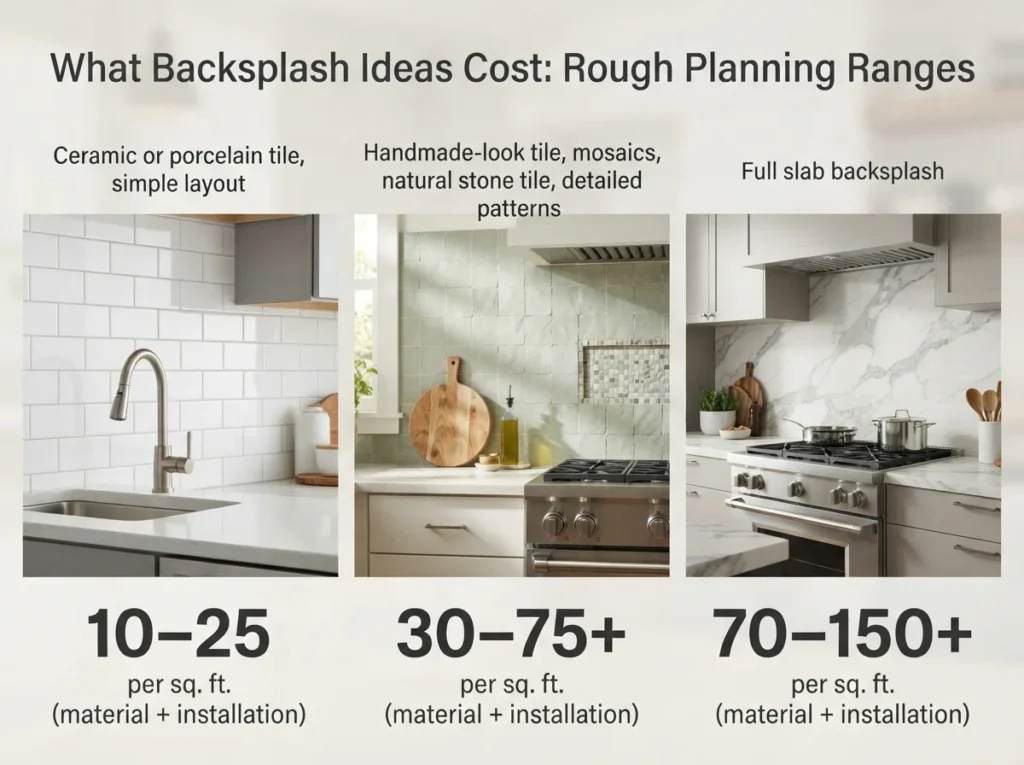
Cost follows material and complexity more than anything else. These are general estimates for installed work, which is why the spread is wide:
| Backsplash type | Estimated installed cost (per sq. ft.) |
| Ceramic or porcelain tile, simple layout | 10–25 |
| Handmade-look tile, mosaics, natural stone tile, detailed patterns | 30–75+ |
| Full slab backsplash | 70–150+ |
These figures are estimates, not confirmed prices. Your final cost depends on factors such as project size, material selection, pattern complexity, layout, cutouts for outlets and windows, labor and installation time, removal of the old backsplash, and other conditions. A written, itemized quote after measurement is the only reliable number.
Full slab work sits at the top because the stone is fabricated and fitted to the wall rather than set piece by piece. For stone in particular, this breakdown of stone backsplash costs in Columbus goes into more detail.
Backsplash Questions Homeowners Ask Before Choosing
How high should a backsplash go?
The standard run is from the countertop to the bottom of the upper cabinets. Taller is the current trend, to the ceiling or the hood, but at any height the walls behind the sink and range take the most splatter, so cover those fully.
Does a tile backsplash need to be sealed?
Glazed ceramic and porcelain tile surfaces typically don’t. Cement-based grout often does, and natural stone like marble usually does too. Epoxy grout is a different product with its own handling. Ask which grout your installer plans to use and what upkeep it needs.
Should I choose the countertop or the backsplash first?
The countertop, in most cases. Its color and veining are the hardest things to change, and a backsplash is easier to judge with that slab sample sitting right beside it.
Planning Your Columbus Kitchen Backsplash
The best kitchen backsplash ideas for Columbus, OH kitchens start with what’s already there: the countertop, the cabinets, the light, and the condition of the walls. Choose a material that fits how you cook and clean, keep the base color grounded, and save the boldest move for one spot, such as the wall behind the range, a full-height run of stone, or a small mosaic panel. Samples beside the real countertop will tell you more than any photo.
When you’re ready to talk through stone or tile options for your own kitchen, contact us or call (380) 266-7082.