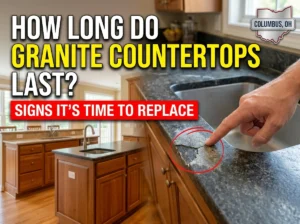
Granite countertops are among the longest-lasting surfaces you can put in a kitchen, and plenty of them are still going strong after 20 or 30 years. So if you’re searching for granite countertop replacement in Columbus, OH, the real question is usually a different one: is what I’m seeing normal wear, something a professional can fix, or a sign the stone has reached the end of its useful life?
This guide helps you sort that out. It covers how long granite typically lasts, which marks are harmless and which aren’t, the specific signs that point toward replacement, how to weigh repair against replacing, and what the process involves if you go ahead.
How Long Do Granite Countertops Last?
With good installation and care, granite can last for decades. Figures you’ll see quoted run from about 15 to 20 years at the low end to 30 years or more, and some trade writers say a lifetime. That spread is real. Granite countertop lifespan depends far more on how a counter was installed and treated than on how old it is.
A few things shorten it:
- Neglected sealing. Granite is natural stone, and the sealer that protects it from stains wears off over time.
- Harsh cleaners. Acidic or abrasive products break down sealer and can dull the finish.
- Thermal shock and impact. A very hot pan on a cold surface, or a hard knock near an edge, can stress the stone.
- Weak support. Overhangs and narrow strips of stone around sink and cooktop cutouts are where many cracks start.
- Installation quality. Uneven cabinets or poorly placed seams cause problems years later.
If your granite went in 15 or 20 years ago and still looks good, age alone isn’t a reason to replace it. Condition is what matters.
Cracks, Stains, and Wear: What’s Normal and What Isn’t
Fissures vs. cracks
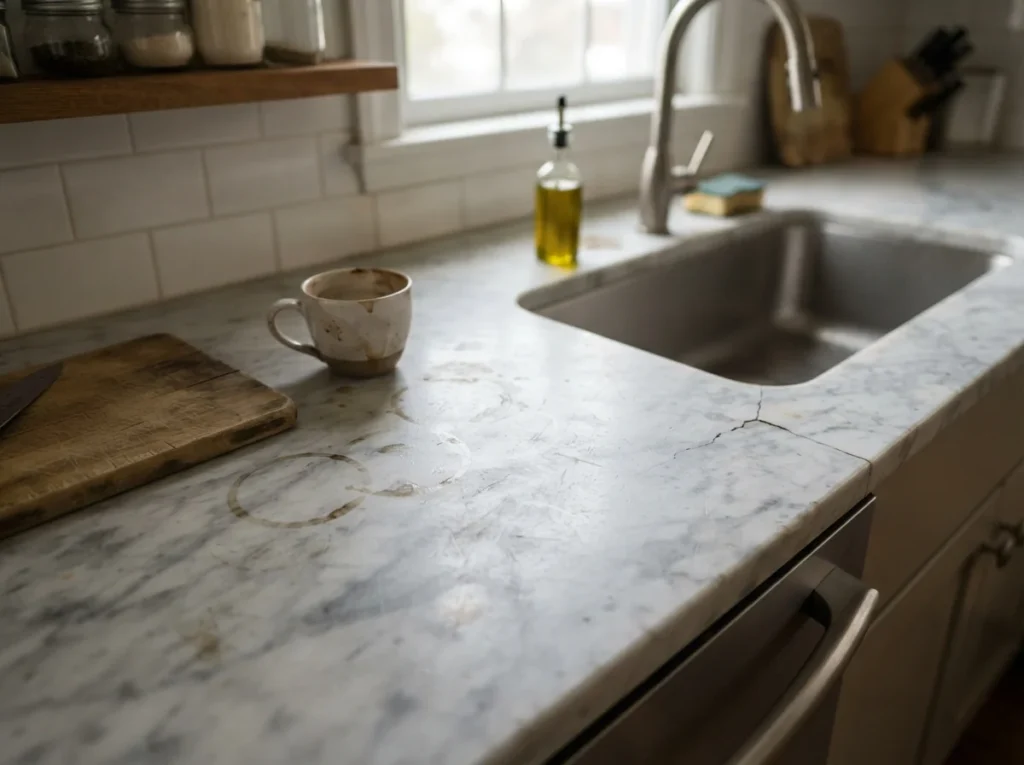
Granite often carries fissures, thin natural lines that formed as the rock cooled, long before it was cut into a slab. The Natural Stone Institute treats fissures as a natural characteristic of stone, not a defect. They tend to look consistent, follow the grain, and have been there since the day of installation.
A crack is different. It’s damage that happened after fabrication, from stress, impact, or poor support. You can often feel one with a fingernail, and it may cast a tiny shadow in raking light, while a fissure usually seems to disappear. A line that is new, growing, or catches your nail deserves attention.
Dull spots, stains, and etching
Dull patches, dark water marks, and stains usually point to worn sealer or acid etching, not a failing slab. A simple check: put a few drops of water on the surface and wait about 30 minutes. If it darkens, the stone is absorbing and likely needs resealing. Our guide to countertop sealing and maintenance in Columbus walks through care in more detail. On some older counters, polishing and resealing no longer fully restores the surface, and that’s when replacement starts to make sense.
Chips and pits
Small chips along edges and tiny pits are common and can usually be filled with color-matched material. Deeper damage near the sink is worth a closer look, since it may mean a bigger problem underneath.
Signs It’s Time to Replace Granite Countertops
Plenty of damaged granite countertops can be saved. These are the situations where repair stops being the sensible choice:
- A crack that runs through a section, moves when pressed, or keeps growing, especially beside a sink or cooktop cutout where the stone is narrowest.
- Several cracks in different places. That often points to a support or installation problem, so patching each one may not solve it.
- Seams that are separating or uneven, particularly if the cabinets have shifted.
- Water damage underneath, such as swollen cabinet panels, staining around the sink, or a musty smell. Moisture may be getting through a failed seam.
- Damage a repair can’t hide, like large chips, thermal marks, or widespread etching.
- A remodel that changes the layout. New cabinets, a bigger island, or a relocated sink usually means new stone, since existing slabs can’t be reshaped to fit.
- A look you’ve outgrown. A granite kitchen upgrade doesn’t require damage. A dated color or edge profile is a legitimate reason on its own.
None of these automatically means replacement. A professional look at the stone and the cabinets underneath sorts out which ones apply to you.
Repair, Resurface, or Replace?
| What you’re seeing | Usual route |
| Small chips or pits | Repair |
| A stable crack that isn’t moving | Repair |
| Dull or stained surface, no damage | Reseal or professional polishing |
| Large, multiple, or moving cracks | Replacement |
| Water damage or failed support underneath | Fix the cause, then likely replace |
| Layout change or outdated style | Replacement |
A common rule of thumb: if the repair would cost around half of what replacement would, replacing usually makes more sense, especially on older counters. For how the same decision looks with other materials, see our guide to when to replace countertops in Columbus.
What it may cost
Crack and chip repairs are often estimated at a few hundred dollars each. For replacement, installed granite is generally estimated at $40 to $200+ per square foot, and many Columbus kitchens fall somewhere between roughly $2,300 and $4,700.
Please note: These prices are estimates only and are not confirmed. Final cost depends on project size, slab selection, edge profile, layout, cutouts, labor and installation time, removal of old countertops, the condition of the cabinets, and other factors. A written, itemized quote after measurement is the only reliable number.
What Granite Countertop Replacement Involves
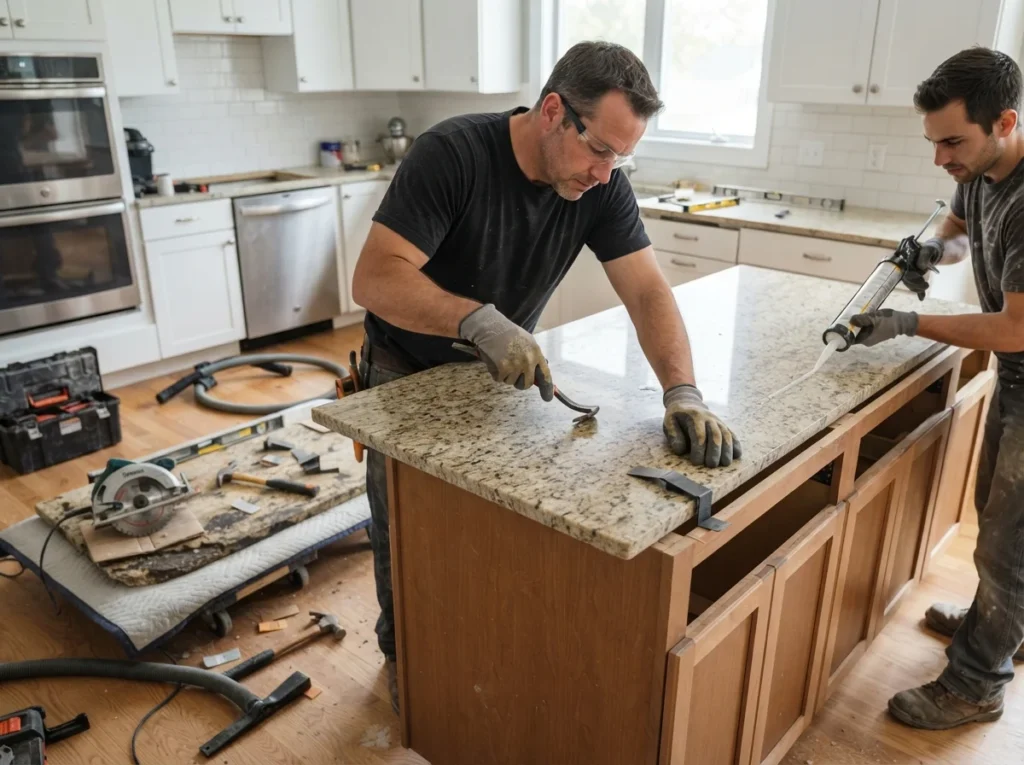
Knowing the sequence helps you ask the right questions:
- A review of the existing counters and the cabinets underneath.
- Slab selection, ideally by viewing the full slab in person.
- Templating once the cabinets are confirmed level and secure.
- Stone fabrication, including edges and cutouts for the sink and cooktop.
- Removal of the old tops, installation, seam finishing, and sink reconnection.
Because the old countertops come out first, ask who handles removal, disposal, and plumbing disconnects, and what happens if removal uncovers water damage or uneven cabinets. Also ask how dust is controlled when stone is cut, since granite contains silica too. A fabricator like Buckeye Rock Tops can walk you through each of these for a kitchen in Columbus or nearby Franklin County communities.
Upgrade Options: New Granite or Something Different
If you’re replacing anyway, it’s a chance to rethink the whole surface. Another granite is a strong choice if you like natural variation and good heat tolerance. A new slab, edge, and finish (polished, honed, or leathered) can change the kitchen’s look a lot. If you’re still deciding which surface best fits your kitchen, explore our countertop material comparison guide to compare different countertop options.
If sealing was what wore you down, quartz removes that task, though it needs trivets and brings its own trade-offs. The same repair-or-replace logic applies to bathroom countertops, where moisture around the sink makes seam and sealer condition especially worth checking.
Frequently Asked Questions
Can a cracked granite countertop be repaired?
Often, yes. Stable cracks and chips can be filled and polished. Cracks caused by poor support, or ones that move, need the cause fixed first, or they tend to come back.
Do I need new cabinets to replace granite?
Not necessarily, but the cabinets must be sound and level to carry the stone. Swollen or damaged cabinets should be repaired before new counters go on.
Can I replace just one section?
Sometimes, depending on the layout and where the seams fall. Natural variation makes an exact color match with older stone difficult, so it’s worth discussing before deciding.
Not Sure What You’re Looking At?
If your granite is cracking, separating, or just no longer fits your kitchen, a professional look can tell you whether repair makes sense or replacement is the better call. Contact us or call (380) 266-7082 to talk through what you’re seeing and what the next step could be.