
If you’re weighing quartz vs. granite countertops for a Columbus kitchen, here’s the short version. Quartz is the easier surface to live with. Granite is the tougher one around heat. Neither is a bad choice. For most households the decision comes down to how you cook, how much upkeep you’ll tolerate, and which slab you like looking at every morning.
That short version leaves out a few things worth knowing before you spend real money: how often granite actually needs sealing, why quartz’s heat weakness is narrower than it sounds, a radon question that comes up often in central Ohio, and what to ask a fabricator about dust control. This guide covers those, then looks at typical pricing and walks through the installation process.
Natural Slab vs. Engineered Slab: Why They Behave Differently
Granite is natural stone, quarried, cut into slabs, and polished. No two slabs match, and the density of the stone varies, which matters for sealing. Quartz countertops are engineered stone. Ground quartz makes up most of the slab, while resin binder and pigment make up the rest. The resin makes quartz non-porous and allows manufacturers to produce consistent patterns, but it also makes the surface more sensitive to heat. If you’re comparing other options for your kitchen, explore our countertop material comparison guide to understand how different surfaces compare.
How Quartz and Granite Hold Up in a Working Kitchen
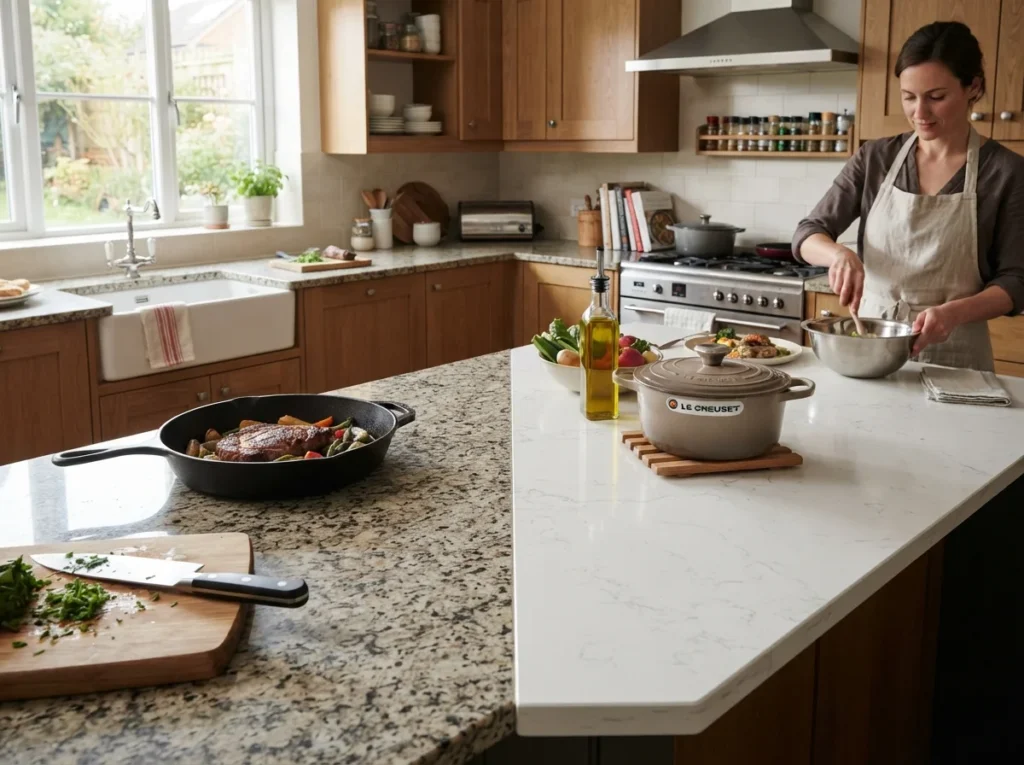
Heat
Granite generally handles hot cookware better, and it’s the one place it clearly leads. The quartz side deserves a precise description instead of a scare. Quartz manufacturers warn that their surfaces can be damaged by sudden temperature changes or direct, sustained heat, especially at the edges. They recommend trivets under pots, pans, and countertop appliances like air fryers, griddles, and slow cookers. Those appliances are the sneaky ones. Nobody sets a blazing skillet down by accident, but a slow cooker running for hours is easy to forget.
Stains and Sealing
Quartz is non-porous, so it never needs sealing. Granite is the variable. Porosity differs from stone to stone, with lighter, more open granites absorbing more than dense dark ones, so a blanket “seal it every year” rule is too much for some counters and not enough for others. The standard trade check is simple: put a few drops of water on the surface and wait about 30 minutes. If it darkens, the stone is absorbing and it’s time to reseal. If it beads, leave it alone. Repeat the test about once a year and let the result set your schedule.
Chips, Cracks, and Looks
Both materials can chip at edges and corners, and the area around the sink takes the most knocks. Cracks tend to be a support or fabrication issue (an unsupported overhang, a narrow strip of stone beside a cooktop cutout) more than a flaw in either material.
On looks, quartz gives you the slab you saw in the showroom, while granite countertops give you character. Choose granite from the actual slab, since a small sample can look quite different from the finished top. Darker granites also tend to disguise marks better.
Radon and Silica: Two Safety Questions Worth Asking
Radon and Granite
Central Ohio has a genuine radon issue, and granite’s reputation sometimes gets tangled up in it. The Ohio Department of Health has found elevated radon in homes in all 88 counties and estimates that roughly half of Ohio homes are affected. On granite specifically, the EPA says radon from the soil under a house is a far larger risk than radon from granite. It also says countertops are extremely unlikely to raise your radiation dose above normal background levels. Its advice is to test every home regardless of what’s on the counters, and if levels come back high, a radon mitigation system is the effective fix, not removing the granite. The EPA’s action level is 4 pCi/L, with a suggestion to consider fixing between 2 and 4.
Silica Dust and Your Fabricator
The second concern affects the people who make the countertop, not the people who use it. Engineered stone can contain 90 percent or more crystalline silica, compared with roughly 10 to 45 percent in typical granite. Cutting, grinding, and polishing it creates fine dust that can cause silicosis, an incurable lung disease. OSHA and NIOSH say the hazard can be controlled with wet cutting, dust collection, and respiratory protection, and OSHA has run an enforcement initiative on engineered stone fabrication and installation since 2023.
Their alert concerns dust created during cutting and finishing, so this isn’t a reason to rule out quartz for your home. It is a reason to ask any fabricator how they control dust, in the shop and in your house if any cutting happens on site. Granite contains silica too, so the question applies to both materials.
What Do Quartz and Granite Countertops Cost in Columbus?
Estimates for countertop installation cost vary widely, and the two materials overlap heavily. These are general installed ranges per square foot:
| Material | Estimated installed cost (per sq ft) |
| Granite | 40–200+ |
| Quartz | 50–200 |
For many Columbus kitchens, typical project estimates land somewhere between roughly $2,300 and $4,700, depending on size and material.
Please note: These prices are estimates only and are not confirmed. Final cost depends on project size, slab selection, edge profile, layout, cutouts, labor and installation time, removal of old countertops, and other factors. A written, itemized quote after measurement is the only reliable number.
What Changes Your Quote
- Size and layout. More square footage, islands, and seams add material and fabrication time.
- Slab grade and color. Rare granite and premium quartz lines cost more than standard options.
- Edge profile and cutouts. Detailed edges, undermount sinks, and cooktop cutouts add labor.
- Labor and time. Complex templating and installation take more hours.
- Extras. Removing old tops, plumbing hookup, and backsplash work are often priced separately.
Ask each quote to itemize these. For a fuller breakdown, see our countertop installation cost guide for Columbus.
Which One Fits Your Kitchen
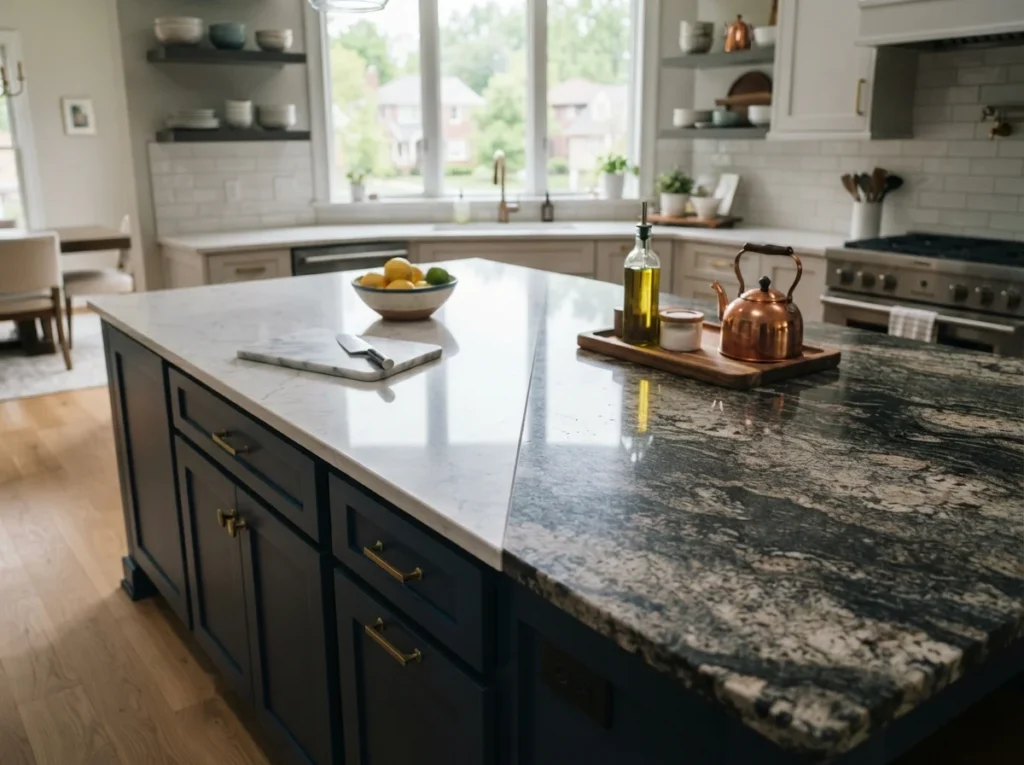
Quartz tends to suit households that want the least upkeep, a uniform look, and strong stain tolerance, and that will use trivets. Granite tends to suit people who cook hard, want natural variation, and don’t mind a yearly water test. Many homeowners split the difference, with granite on the perimeter and quartz on the island or the reverse, as long as the tones coordinate. If you’re still undecided, Buckeye Rock Tops installs both materials, so you can compare them against your own layout.
A few mistakes come up often: choosing granite from a sample instead of a slab, pairing a heavily veined top with a busy backsplash, skipping trivets because “quartz is tough,” and picking a sink or cooktop after templating, when cutouts are made to exact dimensions.
From Slab Selection to Install Day
The sequence matters because a few decisions can’t be undone once stone is cut:
- Measure and discuss layout, material, and budget.
- View the full slab in person and decide how the pattern or veining will run.
- Choose the sink, faucet, and cooktop, ideally on hand before templating.
- Template once the cabinets are installed and secure.
- Fabrication, then installation, seam finishing, and sink reconnection.
Timing varies with slab availability and schedules, so ask for an estimate in writing. When comparing fabricators, a few questions tell you more than a price per square foot: Can I approve the exact slab and review seam placement before it’s cut? Is countertop fabrication done in-house or sent out? How do you control dust? What does the quote include, and what does the workmanship warranty cover?
Frequently Asked Questions
Is quartz or granite cheaper?
The ranges overlap heavily. Entry-level granite often starts a little lower, while premium granite and premium quartz can cost about the same. Slab choice, edges, and layout usually matter more than the material name.
Can I put a hot pan on granite?
Granite generally tolerates heat better than quartz, but rapid temperature swings stress any stone. A trivet is cheap insurance for anything straight off a burner or out of a very hot oven.
Can I use both materials in one kitchen?
Yes. Granite on the perimeter with a quartz island, or the reverse, is common when the colors and veining work together.
Do I need to seal quartz?
No. Mild soap and water handle daily cleaning.
Ready to Compare Slabs?
If you’re at the quote stage, contact us or call (380) 266-7082 to talk through materials, edges, and an itemized quote for your Columbus kitchen.