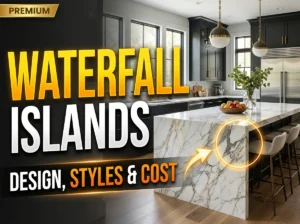
A waterfall island countertop carries the same slab from the top of the island down its side, all the way to the floor, so the stone looks like it’s pouring over the edge. It’s a statement island by design, the kind of detail that becomes the focal point of the room. It also costs more than a standard island, mainly because of the extra material, the fabrication work, and the effort of making the pattern line up.
This guide explains what a waterfall edge involves, the main styles, how vein matching and slab layout affect the result, why the price goes up, and the design details worth settling before anything is cut.
What Makes a Waterfall Island Different
On a standard island, the countertop sits on top of the cabinet and stops at the edge. With a waterfall edge, a vertical piece of the same material runs down the side of the island, replacing what would normally be a finished cabinet end panel. The top and the side panel read as one continuous piece.
Most waterfall ends are mitered: the top and the vertical leg are each cut at a 45-degree angle and joined, so the corner looks like a single thick block of stone with no visible slab thickness at the edge. A butt joint, where one piece simply stacks on another, shows the raw edge instead. The mitered corner is why waterfalls look so clean, and it’s also why they demand careful fabrication, since a miter shows any error quickly.
A waterfall is one of several decisions that shape kitchen island countertops in Columbus, alongside overhang, seating, and material. It’s also the one most likely to affect your budget.
Waterfall Island Styles
One-sided waterfall
A one-sided waterfall island has a single leg, usually on the end facing the room’s main sightline or entrance. It gives you the effect with less material and less visual weight, and it’s the more common choice. It also tends to feel balanced in kitchens where the other end of the island holds seating, storage, or an appliance.
Full waterfall
A full waterfall island has legs on both ends. The result is symmetrical and bold, and it suits larger or open-plan kitchens where the island can handle the visual weight. It also doubles the panel, the joinery, and the material demand, so it sits at the high end of the cost range.
Mitered vs. square corners
Not every waterfall has to be mitered. A square-cut corner, where the leg meets the top at a straight butt joint, is simpler and cheaper, but it shows the edge thickness and loses the sense of one continuous piece. For most people choosing a waterfall, the mitered corner is the point.
Vein Matching and Slab Layout
This is where waterfall islands are won or lost. With a patterned stone, the veining should appear to continue from the top, around the corner, and down the leg. That’s called vein continuity, and achieving it takes planning.
Fabricators do it by cutting the pieces from the same area of a slab or from consecutive, book-matched slabs, where two neighboring slabs mirror each other. They mark the cuts on the slab face to keep the pattern flowing across the miter. The more dramatic the veining, the more the match matters.
The catch is slab yield. Vein matching often means a second slab, and a significant share of the stone can go to waste, sometimes around a third to half, depending on the pattern and the island’s dimensions. That’s why a waterfall can use two slabs where a plain island would use one.
Material changes how demanding this is. Quartz patterns are manufactured and repeat more predictably, so matching is usually easier. Granite, quartzite, and marble are natural stone, and their veining is unpredictable, so matching takes more selection and more waste. Whatever you choose, view the actual slabs and ask to review the layout before cutting begins. Because the top and leg are cut as a set, this is work for a shop that handles custom countertop fabrication and can show you how the pieces will sit on the slab.
What Waterfall Islands Cost: Why the Premium Exists
The waterfall countertop cost premium comes from a few stacked factors:
- Extra material. The vertical leg is additional square footage, and one leg means one more panel.
- A possible second slab. If vein matching needs it, you may pay for a full slab you only partly use.
- Fabrication labor. Mitered edges and matched cuts take more saw time, polishing, and careful joinery than a standard edge.
- Installation effort. Heavy panels need more handling and secure support.
- Island size and number of legs. Larger islands and double waterfalls scale all of the above.
For perspective, trade estimates often put a quartz island with a single waterfall leg at roughly $1,500 to $3,500 above the cost of the base countertop. Some fabricators price the mitered edge by the linear foot, commonly estimated at $50 to $150, compared with $10 to $30 for a standard eased or beveled edge. Two legs, larger islands, and vein-matched marble or quartzite can push the premium higher.
Please note: These prices are estimates only and are not confirmed. Final cost depends on island size, material and slab selection, number of waterfall legs, vein matching, edge profile, cutouts, labor and installation time, and other factors. A written, itemized quote after measurement is the only reliable number.
The most reliable way to price one is an itemized quote that separates material, edge work, and any matching or layout charge, which is how kitchen countertop services typically build an estimate once the island has been measured.
Pros and Cons of a Waterfall Island
What works in its favor
- A strong focal point that makes the island feel custom and intentional
- A clean, continuous look that suits modern and transitional kitchens
- A durable, easy-to-wipe surface on the island’s end in place of a painted panel
What to weigh
- The cost premium, which can be significant
- Material waste when vein matching is involved
- Added weight that the cabinets and floor have to carry
- Less flexibility later, since the leg is part of the countertop
If the main appeal is the look, a thick mitered edge on a standard island can deliver some of the same presence for less. The distinction is covered in the FAQs below.
Design Details to Settle Early
A waterfall is easier to get right when a few details are decided before fabrication:
- Traffic and clearance. A waterfall leg takes up a little space at the island’s end. If that end faces a main walkway, check the clearance and consider softening the corner.
- The cabinet beneath. The leg replaces the usual end panel, so the cabinet’s structure and the finished height need to work with it.
- Weight and support. A full-height panel can reach 200 pounds or more depending on size and material, so confirm the cabinets, floor, and installation plan can handle it.
- Access. Large slabs and legs have to get through doors and around corners. Ask how the pieces will be delivered.
- Seating and legroom. Decide which sides of the island will be used for stools before choosing which end gets the waterfall.
- Pairing with the rest of the kitchen. A bold, veined waterfall usually calls for quieter surfaces around it, including the backsplash.
Buckeye Rock Tops fabricates and installs countertops for homeowners across Columbus and Central Ohio, and these are the kinds of questions worth raising with any fabricator before you commit to a slab.
Frequently Asked Questions
What’s the difference between a waterfall edge and a mitered edge?
A waterfall carries a vertical panel down the side of the island to the floor. A mitered edge is a thickened edge on the top itself, made by joining angled pieces so the counter looks like a thicker slab. A mitered edge gives presence without the full-height commitment.
Does a waterfall island need extra support?
It usually needs careful attention. The leg adds weight, and the cabinet end, floor, and installation method should be reviewed with your fabricator and cabinet installer.
Can a waterfall be added to an existing island?
Sometimes, but it depends on how the existing cabinet end is built and whether the countertop can be replaced as a set. It’s usually easier to plan the waterfall with a new top.
Thinking About a Waterfall Island?
If you’re weighing a waterfall for your kitchen, a conversation about your island’s size, layout, and sightlines can clarify whether it fits and what it might involve. Reach out to the Buckeye Rock Tops team or call (380) 266-7082 to talk through your island.