
but needs more care around stains and acidic products.
Size, sink style, edge detail, backsplash, and daily use also matter. A beautiful material can still be the wrong choice if it does not fit the way you use your bathroom. Buckeye Rock Tops offers custom stone countertop options for bathroom and kitchen projects, including quartz, granite, and marble.
What Is the Best Material for a Bathroom Vanity Top?
For many bathrooms, quartz is the easiest material to live with because it is nonporous and does not normally need sealing. Granite is a good choice if you prefer natural stone and do not mind checking its care needs. Marble has a classic look, but it can need more attention to stains, etching, and surface care.
There is no single material that is best for every bathroom.
A busy family bathroom may need a surface that is simple to wipe down. A guest bath may be used less, so design can carry more weight. In a primary bathroom, you may care more about a large custom vanity, two sinks, storage, and the way the countertop ties the whole room together.
The right choice should fit both the room and the people using it.
Is Quartz Good for Bathroom Countertops?
A quartz vanity is one of the easier options for a bathroom that sees daily use. Quartz is engineered and has a nonporous surface. That helps it resist moisture and many common stains, while also removing the need for routine sealing on products such as Cambria quartz.
Quartz also comes in many colors and patterns.
You can choose a simple white surface for a small vanity or use stronger veining for a larger primary bathroom. Some quartz designs give a marble-like look without the same care routine as natural marble.
The surface is not impossible to damage, though. Strong chemicals and rough cleaning products should still be avoided. Manufacturer care instructions should always come first.
If quartz is already high on your list, Buckeye Rock Tops provides bathroom countertop installation and custom vanity work for stone surfaces.
When Does Granite Make More Sense?
A granite vanity can be a better fit when you want a natural stone surface with its own pattern and color. Every granite slab is different. That natural variation can give a bathroom more character than a surface with a controlled pattern.
Granite is also a durable countertop material. However, care needs can vary by stone.
There is a common idea that every granite counter needs sealing on a fixed yearly schedule. That is not always true. The Natural Stone Institute says many granite countertops may not require sealing, and the need depends on the stone.
Ask the fabricator about the exact slab you choose. They can tell you if the stone should be sealed and what products are safe for regular cleaning.
Is Marble a Good Choice for a Bathroom Vanity?
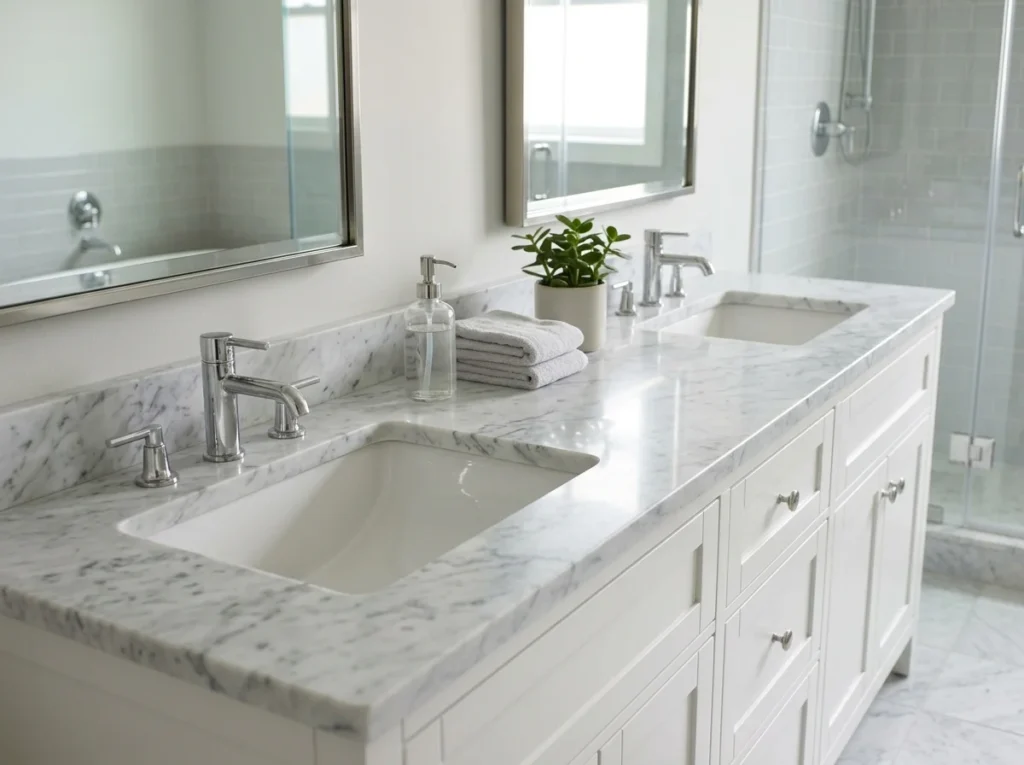
A marble vanity can give a bathroom a softer and more natural look. Each slab has its own veining, so the finished top can become one of the main design features in the room.
The trade-off is care.
Marble is a natural stone, and it needs more attention than many quartz surfaces. Products left on the counter can stain or affect some finishes. Acidic products can also be a concern with calcite-based stones such as marble.
That does not make marble a bad bathroom material. It means you should choose it because you like natural stone enough to accept its care needs.
For regular natural-stone cleaning, the Natural Stone Institute recommends a neutral stone cleaner or mild dish detergent with warm water rather than harsh cleaning products.
Quartz vs. Granite vs. Marble for a Bathroom
The three materials can all work in bathrooms, but they solve different needs.
| Material | Best Fit | Main Benefit | Main Consideration |
| Quartz | Busy bathrooms | Simple care and nonporous surface | Protect from harsh products and high heat |
| Granite | Natural-stone designs | Unique slab patterns | Care and sealing needs vary by stone |
| Marble | High-end vanity designs | Natural veining and classic look | Needs more careful cleaning and stain control |
Quartz is often the easier choice for everyday use. Granite gives you natural variation without the same delicate feel as many marble surfaces. Marble works best when the look matters enough to justify the extra care.
If you are still comparing stone types, Buckeye Rock Tops’ countertop material comparison guide goes deeper into the differences between quartz, granite, and marble.
How Much Do Bathroom Vanity Countertops Cost?
The cost of a bathroom countertop depends on the material, vanity size, slab choice, sink cutout, edge profile, backsplash, removal work, and installation. A small single-sink vanity may use far less material than a wide double vanity.
Current 2026 pricing guides also show very broad material ranges. Quartz, granite, and marble can each move from basic to premium price levels depending on the slab and project details. That makes national averages useful for early planning but weak as a final Zanesville estimate.
A better approach is to price the actual vanity.
Give the fabricator the cabinet width, sink type, backsplash plan, and material you are considering. That gives you a much clearer estimate than multiplying a random square-foot number by the size of the bathroom.
What Else Changes the Vanity Top Price?
The slab is only one part of the cost.
An undermount sink needs a finished cutout. Faucet holes need to match the fixture. A detailed edge can take more fabrication than a simple edge. Matching stone backsplash pieces also add material and cutting.
Your existing counter matters too.
If this is a bathroom vanity countertop replacement, the old surface may need to be removed before measurements or final installation. The vanity cabinet also needs to be stable and level enough for the new top.
A simple vanity can therefore cost much less than a custom setup with two sinks, detailed edges, a full backsplash, and premium stone.
Ask what the quote includes before comparing different companies.
Which Sink Works Best With a Stone Vanity Top?
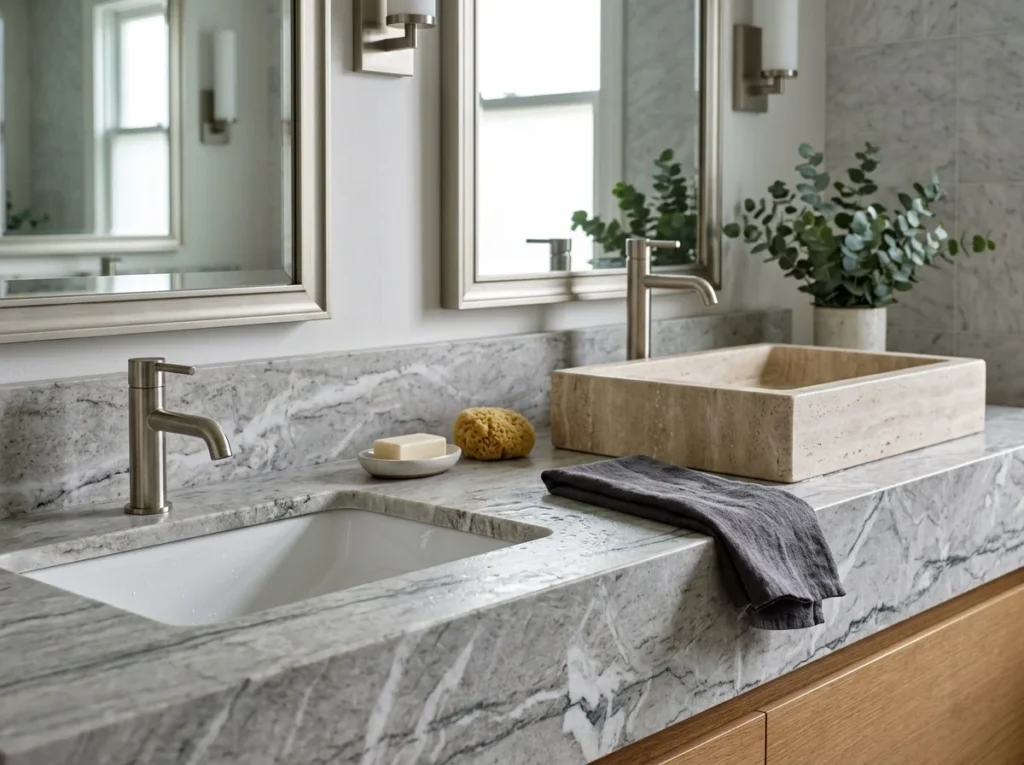
Undermount and vessel sinks can both work with stone bathroom vanity tops, but they create very different designs.
An undermount sink sits below the countertop. It gives the vanity a clean look and leaves more of the stone visible around the sink. The opening needs to be cut and finished accurately because the edge remains visible.
A vessel sink sits above the countertop. This can make the sink more of a design feature, but faucet height and placement need more thought.
The vanity cabinet, drain position, faucet, and countertop measurements should all be planned together. Choosing each item on its own can create fitting problems later.
Should You Add a Bathroom Backsplash?
A backsplash can help protect the wall behind the sink from water, soap, toothpaste, and daily splashes. It also gives the vanity a more finished look.
You do not always need a large backsplash.
A short matching stone piece can be enough for a simple vanity. A full-height tile backsplash can add more color or texture. Some bathrooms use the same stone from the vanity top on part of the wall for a more connected design.
Look at the room as one space.
The vanity, mirror, faucet, wall color, backsplash, and countertop should work together rather than competing for attention.
Which Countertop Edge Is Best for a Bathroom?
Simple edges work well for most bathroom vanities because the space is usually smaller than a kitchen counter.
A clean edge can make the countertop feel lighter and keep attention on the stone pattern. Rounded edges can also soften the look around a busy family bathroom.
More detailed edge profiles may suit traditional vanities.
Before choosing one, ask if the edge works with the slab thickness and sink design. The edge profile can also change the fabrication cost.
The best choice is usually the one that suits the vanity instead of the most decorative option available.
Why Accurate Vanity Measurements Matter
A custom stone top needs accurate measurements. Even a small error can affect the wall fit, sink position, faucet holes, overhang, or backsplash.
Measurements become even more important with a double vanity. Both sink openings need to line up with the cabinet and plumbing below.
This is why professional fabrication starts before installation day.
Buckeye Rock Tops says it handles stone work from templating through fabrication and final fitting at its Columbus workshop. Its process includes cutting, edging, and polishing granite, quartz, and marble before installation.
Good fabrication is what turns a slab into a countertop made for the actual bathroom.
What Happens During Vanity Top Installation?
Professional vanity countertop installation normally starts after the vanity cabinet is in its final position. The installer checks the base, places the fabricated stone, confirms the fit, and handles the seams when more than one piece is needed.
Sink and faucet planning should already be complete by this stage.
Buckeye Rock Tops notes that countertop installation can include issues such as unlevel cabinets, seam alignment, heavy slab placement, and sink integration. Checking these details before the job is finished can prevent fitting problems later.
Do not plan the countertop as a separate item from the vanity and sink. All three need to work together.
How Do You Protect a Bathroom Countertop From Moisture?
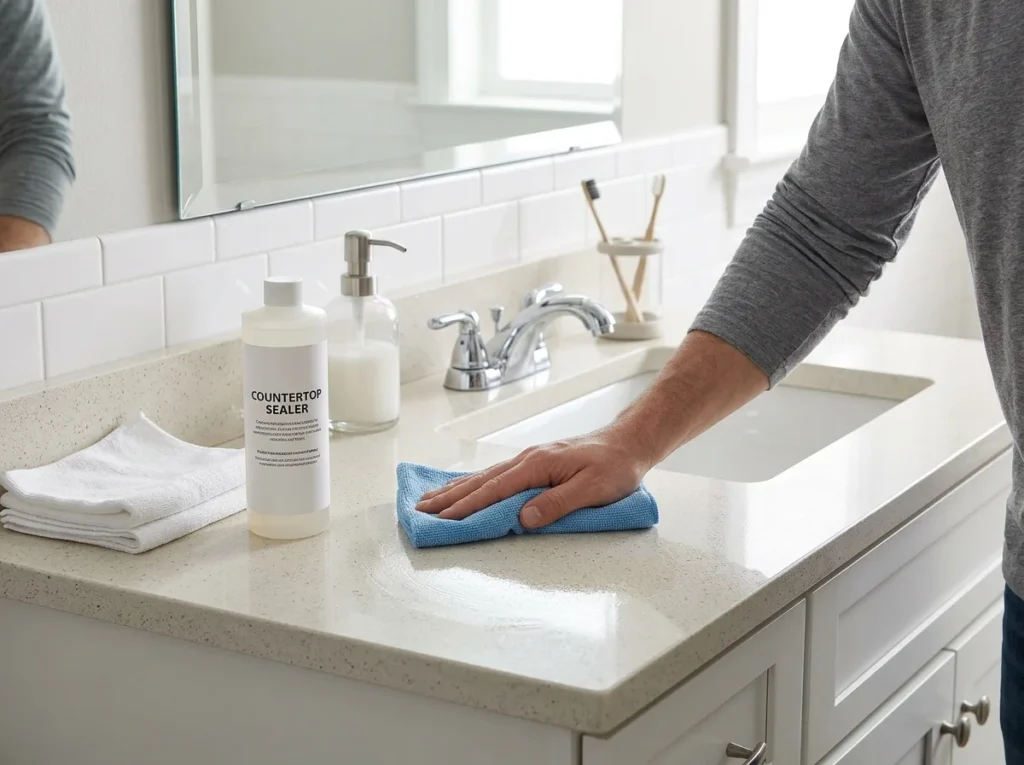
Start by choosing a material suited to bathroom use and following the right care routine for that surface.
Quartz has an advantage because many quartz products are nonporous. Cambria says its quartz is nonabsorbent and does not require sealing. Natural stone should be cleaned with products suited to that stone, and sealing needs should be checked rather than guessed.
Also pay attention to the areas around the sink and backsplash.
Water left around fixtures can create residue even when it does not soak into the counter. Wiping the vanity after heavy use can keep the whole space easier to clean.
For more detail, this guide to bathroom countertop materials and moisture resistance explains how material choice affects bathroom use.
When Should You Replace a Bathroom Vanity Top?
Bathroom vanity countertop replacement makes sense when the current surface is damaged, badly stained, cracked, hard to clean, or no longer fits the bathroom design.
A new top can also make sense when you are replacing the vanity cabinet or changing sinks.
Do not assume the entire bathroom needs to be remodeled just because the countertop looks old. If the vanity base is still strong and the layout works, changing the top, sink, faucet, and backsplash can give the area a much newer look.
Before ordering stone, make sure the cabinet is worth keeping.
A heavy new surface will not solve problems with a weak, damaged, or badly fitted vanity base.
What Should You Ask Before Ordering a Custom Vanity Top?
A clear estimate should tell you more than the material price.
Ask about measurements, slab choice, countertop thickness, sink cutouts, faucet holes, edges, backsplash, old-counter removal, delivery, and installation.
Also ask to see the actual slab or a large sample when possible.
Natural granite and marble can vary from one piece to another. Quartz patterns can also look very different when you move from a small sample to a full vanity.
Before scheduling a project from Zanesville, it is also worth checking Buckeye Rock Tops’ current Central Ohio service area and confirming service for your address. The company’s published list currently focuses on Central Ohio communities and does not show a dedicated Zanesville location page.
FAQs About Bathroom Countertops in Zanesville
What is the easiest bathroom countertop to maintain?
Quartz is one of the simplest stone-style surfaces to maintain because it is nonporous and normally does not need routine sealing. Mild soap, warm water, and a soft cloth are enough for many everyday messes.
Is granite or quartz better for a bathroom vanity?
Quartz may be better if low maintenance is your top goal. Granite may be better if you want natural stone and unique slab patterns. Both can work well when properly fabricated and installed.
Does a bathroom vanity top need a backsplash?
Not always, but a backsplash helps protect the wall from sink splashes and can make the vanity look more finished. It can be made from matching stone, tile, or another bathroom-safe material.
Can you install an undermount sink with quartz or granite?
Yes. Both materials can be fabricated for undermount sinks. Accurate measurements and a clean sink cutout are important because the stone edge around the sink stays visible.
Does granite need to be sealed every year?
Not always. The Natural Stone Institute says many granite countertops do not need sealing. The need depends on the stone, so ask about the specific slab rather than following a fixed schedule.
Should I replace the vanity cabinet at the same time?
Only if the cabinet is damaged, unstable, poorly sized, or no longer fits your design. A strong vanity cabinet may be able to support a new custom countertop without replacing the whole unit.
Choose a Vanity Top That Fits Your Bathroom
The best bathroom countertops Zanesville OH homeowners choose should work with daily routines as well as the room’s design. Quartz is a strong option for simple care. Granite offers natural patterns and a durable surface. Marble brings a more classic stone look but needs more careful upkeep.
Do not make the decision from a small material sample alone. Think about the vanity size, sink style, faucet, edge, backsplash, cleaning needs, and the amount of use the bathroom gets.
If you are ready to compare quartz, granite, or marble for a custom bathroom countertop, you can request a project estimate from Buckeye Rock Tops and confirm service availability for your Zanesville address.