Two granite slabs can have nearly identical color and veining yet create very different-looking kitchens once installed. One has a slim front edge; the other looks substantial against the cabinets. Beyond appearance, slab thickness influences weight, fabrication options, and how the countertop must be supported. Making that choice before the final template helps prevent changes to the design after stone has been ordered.
Kitchen countertop thickness commonly comes down to choosing between 2 cm and 3 cm stone. Neither option is automatically right for every kitchen, and thicker does not mean scratch-proof or free from support requirements. The practical choice depends on your selected granite or quartz, cabinet arrangement, sink and appliance openings, island overhang, and preferred edge appearance. A fabricator should evaluate those details together rather than selling thickness as a stand-alone upgrade.
What Are the Standard Thickness Options for Stone Countertops?
For residential granite and engineered quartz, 2 cm and 3 cm are widely available nominal slab thicknesses. Two centimeters measures about 0.79 inch, commonly described as three-quarters of an inch, while 3 cm measures about 1.18 inches, often marketed as roughly one and one-quarter inches. Some brands also offer 1 cm products, which need separate installation guidance.
| Feature | 2 cm | 3 cm |
| Look | Slim | Fuller |
| Relative weight | Lower | About 50% higher |
| Support | Product-specific | Product-specific |
| Edge options | Some need build-up | More full-depth choices |
What Changes When You Choose 2 cm Instead of 3 cm?
A 2 cm slab produces a lighter visual line at the cabinet front and can suit contemporary kitchens with simple, restrained details. It also contains less stone by volume, making the slab lighter when the material and surface area are otherwise the same. However, savings in weight do not establish that existing cabinets are suitable. Depending on the product, fabrication, and unsupported spans, the design may call for plywood substrate, rails, or other reinforcement.
Three-centimeter stone creates a deeper edge without requiring an applied strip just to look thick. It is common for kitchen counters and islands because its greater cross-section can offer more flexibility for certain layouts. Still, thicker stone increases the load delivered to cabinets and floors, and it does not remove the need to support seams, cutouts, or projections. Ask which thicknesses are offered in the exact slab color rather than assuming every collection provides both.
Is a Thicker Countertop Always More Durable?
Thickness affects the structural behavior of a slab, but it does not change every performance characteristic. Within the same product family, a thicker slab generally has greater resistance to bending under comparable conditions. That is separate from surface hardness, stain resistance, and everyday cleaning. Cambria states that its 2 cm and 3 cm quartz countertops have the same fundamental surface durability and maintenance characteristics, despite differences in profile and installation considerations.
A well-supported 2 cm installation can perform properly, while a poorly supported 3 cm slab can still crack around an opening or develop problems at a joint. Natural granite also varies from slab to slab, so material characteristics and fabrication quality matter alongside thickness. The best question for the fabricator is not simply which slab is stronger, but whether the chosen thickness works with the actual layout and support structure.
How Does Thickness Affect Cabinet and Substrate Requirements?
Countertops transfer their weight through cabinet rails, partitions, panels, and supporting structures. A heavier slab increases that load, while a thinner one may need additional support to limit flexing. There is no universal cabinet weight rating or blanket plywood rule that fits every brand and project. Manufacturer instructions vary, especially for 2 cm products, so avoid assuming that all thin slabs require the same subtop or that every 3 cm surface needs none.
Before ordering, the installer should confirm that the cabinets are secured, level, and suitably supported, particularly near sinks, dishwashers, and long gaps between cabinet sides. Buckeye Rock Tops describes these base-support and fitting checks as part of its countertop installation work. If the existing cabinets are damaged or moving, that condition needs attention regardless of thickness; choosing a heavier slab will not stabilize weakened cabinetry.
Will a 3 cm Slab Put Too Much Weight on Existing Cabinets?
For equal countertop area and the same stone density, a 3 cm slab contains about one-and-a-half times as much material as a 2 cm slab. Actual pounds per square foot depend on the product, so published figures from one quartz or granite supplier should not be applied to every stone. Existing cabinets may be perfectly suitable for either choice, but the assessment should include their condition, fasteners, supporting floor, and any concentrated loads.
Does Countertop Thickness Change How Far an Island Can Overhang?
Yes, thickness may affect the amount of projection possible before added support becomes necessary, but the allowable distance is not universal. Manufacturers set their own limits based on material, slab thickness, base depth, and reinforcement. Some layouts require brackets or steel even with 3 cm stone, especially where people may lean on a seating extension. An overhang should never be approved solely because the slab looks thick enough to carry itself.
If the kitchen includes island seating, confirm the planned projection, cabinet depth, and locations of any support brackets before the final stone drawing is approved. The separate kitchen island overhang guide covers seating clearances and support arrangements in greater depth. That broader layout decision is worth settling early because it may affect both the selected slab thickness and the amount of legroom available after supports are installed.
Can a Thin Slab Be Made to Look Thicker at the Edge?
Yes. A fabricator may use a laminated edge strip or a carefully joined mitered edge to create a thicker-looking face while keeping the main slab comparatively thin. The visible edge depth can therefore be different from the actual slab thickness. These techniques can suit a bold island design, but the added pieces introduce fabrication work and must be properly bonded and aligned to the stone’s pattern.
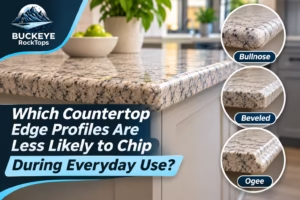
A built-up edge is an appearance treatment, not proof that the full countertop has the strength of a solid slab of that visible depth. Certain ogee, bullnose, or other decorative profiles may also be limited by the selected thickness and manufacturer. Buckeye Rock Tops’ custom countertop fabrication service is a relevant place to discuss edge construction once a material and layout have been selected. Request an actual cross-section sample if possible.
What About Sink Openings, Cooktops, and Seams?
Stone is interrupted at sink and cooktop cutouts, leaving narrower areas that require careful support and fabrication. Thickness is one factor, but inside-corner geometry, remaining stone width, seam placement, and mounting arrangements can matter just as much. A thicker slab does not excuse unsupported sinks or poorly located joints. Review appliance and sink specifications with the fabricator before approving the openings.
Does 2 cm Stone Always Cost Less Than 3 cm?
Not necessarily after installation. A thinner slab may use less material and cost less at the supplier, yet extra substrate, edge build-up, handling, or support work can change the finished price. Three-centimeter material may be more expensive to purchase and transport, but a straightforward edge may reduce additional fabrication steps. Availability and stone pattern can also change the quote, making a simple percentage comparison unreliable across different projects.
Ask for itemized estimates that show the slab, fabrication, edge treatment, support materials, and installation separately. The countertop installation cost guide outlines other budgeting factors in Columbus. Actual thickness-specific pricing should come from a written quote for your chosen product and dimensions, not a generic online range that omits additional support or decorative work.
How Should You Make the Final Thickness Decision?
Start with your preferred stone and ask which nominal thicknesses are actually available in that color and finish. Next, compare real samples at cabinet height, not just small pieces lying flat on a table. Finally, review the kitchen plan with a fabricator: cabinet condition, sink and cooktop openings, island seating, edge design, and installation requirements. A clear answer should explain the trade-offs for your particular layout without presenting one thickness as mandatory for everyone.
Frequently Asked Questions
Is 3 cm Better Than 2 cm for Kitchen Countertops?
Three-centimeter stone is a common kitchen choice and may provide more flexibility for some edge and overhang designs, but it is not automatically better for every project. Two-centimeter countertops can also work well when the product is approved for horizontal use and the supporting assembly is designed accordingly. Surface care and resistance to everyday staining are not necessarily improved by extra thickness. Compare the manufacturer’s requirements against your actual layout.
Do All 2 cm Quartz Countertops Need Plywood Underneath?
No universal rule applies to every quartz brand or installation. Some manufacturers and systems specify a continuous subtop for 2 cm horizontal counters, while others provide installation details based on support spacing and deflection. The requirements may change around openings or long projections. A fabricator should use the selected product’s current instructions rather than assume that a recommendation for one quartz collection applies to every other product on the market.
Does a Thick-Looking Countertop Mean the Slab Is 3 cm?
Not necessarily. Edge build-up and mitered fabrication can make a thin slab look much deeper at the front. The visible edge therefore may not reflect the thickness of the stone spanning the cabinet opening. Ask to see the actual slab specification and an explanation of how any decorative edge is constructed. This matters when discussing cabinet loads and support, because an applied edge does not turn the entire slab into solid thicker stone.
Can Countertop Thickness Change the Finished Kitchen Height?
Yes. If the cabinet top stays at the same elevation and no other layers change, a thicker slab raises the finished work surface. However, substrates, cabinet leveling, and edge treatments can also affect the final result. Check appliance clearances and backsplash dimensions if replacing an existing counter with a different thickness. Your fabricator should confirm the finished elevation during measurement instead of assuming the old and new surfaces will align automatically.
Choose the Thickness That Works With Your Kitchen
Both 2 cm and 3 cm can be sensible choices when material specifications, support, and fabrication are coordinated. The difference is not merely the appearance of the front edge; it can affect weight, layout flexibility, and the installed cost. For a granite or quartz kitchen countertop project in Columbus, OH, contact Buckeye Rock Tops or call (380) 266-7082 to review slab options and project-specific requirements before fabrication.